

PFAS and Forever Chemicals: What They Are, Health Effects, and How to Reduce Exposure
PFAS (per- and polyfluoroalkyl substances), commonly called forever chemicals, are a group of more than 15,000 human-made chemicals used to make products resistant to heat, grease, stains, and water. Because PFAS do not easily break down in the environment or the human body, they can accumulate over time and have been associated with endocrine disruption, fertility challenges, immune dysfunction, certain cancers, and other long-term health concerns.
The Forever Chemicals in Your Home and Body Were Invented for WWII
The chemicals in your nonstick pan, waterproof jacket, and couch were invented to help American soldiers win World War II. In this 9-minute overview, Sophia Ruan Gushée explains how they ended up in your home—and inside you—and what you can do about it.
Watch on YouTube →This video is an excerpt from Sophia's 4-day Forever Chemicals Detox crash course, originally recorded in September 2022. Some regulatory details have evolved since recording—for the latest, see the sections below.
- PFAS are a class of 15,000+ synthetic chemicals used in nonstick, stain-resistant, and water-repellent products.
- They are called "forever chemicals" because they resist breakdown in the environment and accumulate in the human body.
- Peer-reviewed research has associated PFAS exposure with thyroid, reproductive, immune, and certain cancer outcomes.
- The EPA finalized the first enforceable federal drinking water standards for six PFAS compounds in April 2024.
- The most effective strategy is reducing ongoing exposure through water filtration, cookware choices, food packaging, and textiles.
- What are PFAS and why are they called "forever chemicals"?
- Health risks of PFAS
- Why low-dose exposure still matters
- Where PFAS hide in everyday products
- How to reduce PFAS exposure at home
- Recent developments
- Frequently asked questions
- Forever Chemicals Detox podcast series
- Sources & further reading
The Basics
What Are PFAS and Why Are They Called "Forever Chemicals"?
PFAS are synthetic chemicals developed for durability. That same durability is what makes them a concern for human health and the environment.
Why PFAS persist in the body and environment
- Resist breakdown in air, water, and soil
- Accumulate in food chains and human tissue
- Remain in the body long after exposure ends, with elimination half-lives measured in years for compounds like PFOS and PFOA
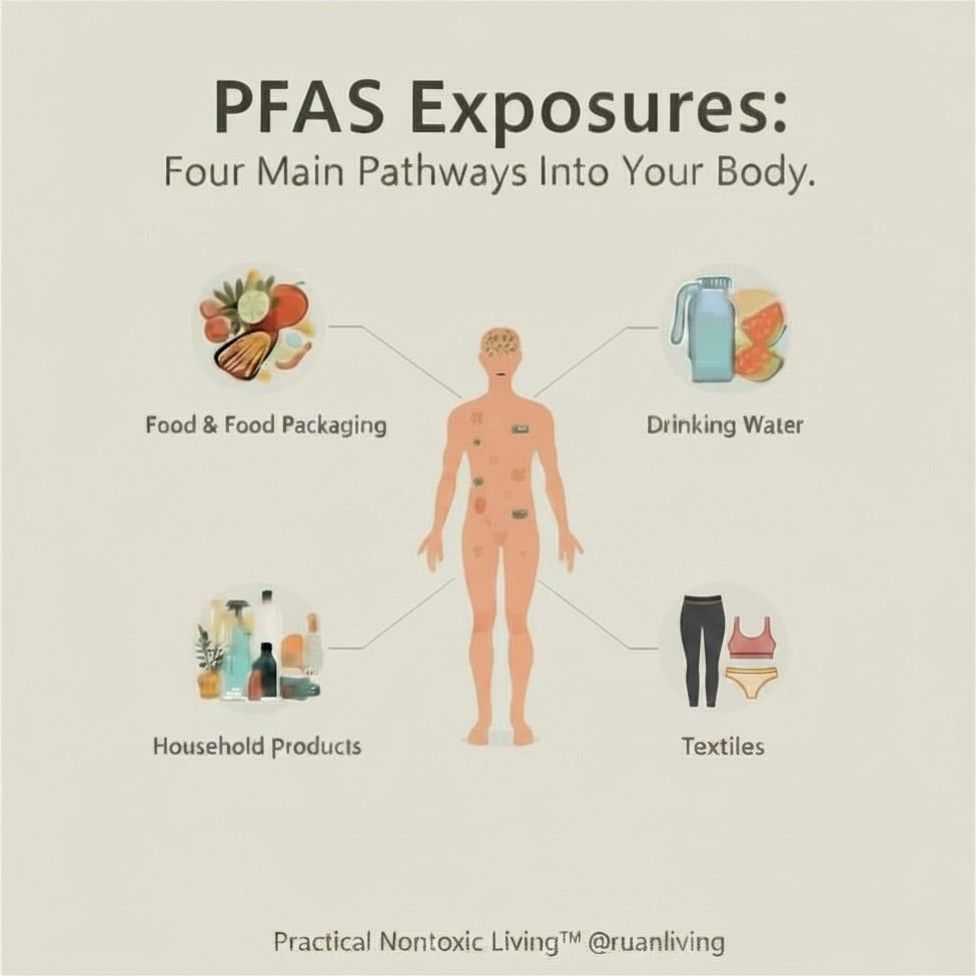
How people are exposed to PFAS
PFAS also reach us through indoor air and household dust.
These exposures are nearly universal. Studies measuring PFAS in the blood of healthy volunteers have found detectable levels in more than 95% of Americans, according to Stanford Medicine.
Forever chemicals earn their name—they resist breakdown in the environment and quietly build up in the body.
Health Effects
Health Risks of PFAS and Forever Chemicals
Scientific bodies including the Endocrine Society have identified PFAS as endocrine-disrupting chemicals, meaning they can interfere with hormone signaling at very low doses.
PFAS, hormone disruption, and reproductive health
Peer-reviewed studies have associated PFAS exposure with thyroid dysfunction, reproductive hormone imbalance, fertility challenges, and developmental effects.
PFAS and cancer, immune, and chronic disease risks
Scientific research has associated PFAS exposure with certain cancers, immune system suppression, pregnancy complications, and metabolic and cardiovascular effects. In 2023, the International Agency for Research on Cancer (IARC) classified PFOA as a Group 1 carcinogen (carcinogenic to humans) and PFOS as Group 2B (possibly carcinogenic to humans).
According to the U.S. Environmental Protection Agency and the federal Agency for Toxic Substances and Disease Registry (ATSDR), peer-reviewed research has associated PFAS exposure with a range of effects—though the strength of the evidence varies by compound and by outcome. Reported associations include:
- Increased cholesterol levels
- Reduced antibody response to vaccines, including in children
- Changes in liver enzymes
- Pregnancy-induced hypertension and preeclampsia
- Small decreases in infant birth weight
- Increased risk of kidney and testicular cancer
Both agencies stress that this science is still evolving. ATSDR describes the epidemiological evidence as "suggesting associations" rather than proving cause, and the EPA notes that research is ongoing to determine how different PFAS and different exposure levels affect health. In practical terms, that uncertainty is a reason to reduce avoidable exposure—not to panic.
"Each new study that comes out concerns us more—not just because of what these chemicals do, but because of how hard it is to get rid of them once they're out there."Lisa Patel, MD · Stanford Medicine
PFAS, epigenetics, and why your genes aren't your destiny
While genetics influence health risk, environmental exposures help determine how genes are expressed. Emerging research on PFAS suggests exposure may influence health outcomes across generations through epigenetic mechanisms. Stanford Medicine environmental epidemiologist Andres Cardenas and colleagues have reported that PFAS do not appear to alter DNA directly, but can change when and where genes are switched on—a process known as epigenetic regulation (Stanford Medicine). Learn more in our podcast episode: Your Genes Aren't Your Destiny: How Everyday Household Exposures Shape Your Health.
The Science
Why Low-Dose PFAS Exposure Still Matters
Why "safe" levels are difficult to establish
PFAS can cause biological effects at extremely low doses due to non-monotonic dose-response relationships, hormone-mimicking behavior, and cumulative exposure over time. This concept is well-documented in the peer-reviewed literature on endocrine-disrupting chemicals. Learn more in our podcast episode: When Less Isn't Safe: How Low Doses of Toxins Affect Your Health.
Why daily PFAS exposures add up
Daily contact across food, water, products, and indoor environments can create a chronic chemical burden that may affect health over time.
The dose that matters most often isn't one big exposure. It's the small, daily ones that add up.
In Your Home
Where PFAS Hide in Everyday Products
Household Repeat Offenders™
- Traditional nonstick cookware and bakeware manufactured with PFAS
- Grease-resistant food wrappers and containers
- Furniture, carpets, and rugs treated with PFAS-based stain repellents
- Water- and dirt-repellent clothing and textiles
- Certain cleaning and personal care products
Learn more in our podcast episode: Household Repeat Offenders™: Everyday Products That Hide Forever Chemicals (PFAS).
Community-wide PFAS contamination
PFAS contamination has affected drinking water supplies in many communities, sometimes years before it is publicly disclosed. The EPA's 2024 drinking water rule requires public water systems to monitor for six PFAS compounds and notify the public of results. Hear one family's story in our podcast episode: When Forever Chemicals Hit Home: How Senator Judy Seeberger Turned PFAS Contamination into Hope.
What To Do
How to Reduce PFAS Exposure at Home
You can't quickly "detox" PFAS that are already in your body—research shows forever chemicals leave slowly, over years—so the most effective, evidence-based way to lower your PFAS body burden over time is to reduce ongoing exposure. These are the changes that matter most.
Simple ways to reduce forever chemical exposure
- Filter drinking water with a certified PFAS-reducing filter (look for NSF/ANSI 53 or 58 certification). Not sure which to buy? See our guide to how to choose the right water filter for your home.
- Avoid traditional nonstick cookware when possible; choose cast iron, stainless steel, carbon steel, glass, or enameled cast iron. Here's the hidden dangers of Teflon® and PFAS, and why nonstick is worth rethinking.
- Be cautious with stain- and water-resistant products.
- Reduce reliance on grease-resistant food packaging like microwave popcorn bags and some fast-food wrappers.
- Bring your own container for restaurant leftovers and takeout, since grease-resistant wrappers and boxes are a common source—a simple swap Stanford Medicine clinicians suggest.
- Dust and vacuum with a HEPA filter to reduce indoor dust exposure.
Highest-impact changes to focus on first
- Food contact materials (cookware, packaging, storage containers)
- Personal care and skin contact products
- Indoor environments and household dust
For the easiest free steps, listen to our podcast episode: The 6 Easiest (and Free!) Ways to Cut Forever Chemicals from Your Life.
Stanford Medicine's researchers are candid that the largest reductions in PFAS exposure will come from stronger regulation and from manufacturers using fewer of these chemicals. But that kind of change takes years. In the meantime, reducing your own exposure at home is the most effective thing you can do now—and it's exactly what the Ultimate Home Detox™ is built for. The free Kickstart series is the simplest place to begin.
Start Reducing Your PFAS Exposure Today
Join the free Ultimate Home Detox™ Kickstart Series—10 daily emails with practical shifts to reduce your toxic exposures.
- 10 daily emails with small, science-backed shifts
- The Forever Chemicals Detox Guide (PDF)
- The Nontoxic Cleaning Guide (PDF)
One small shift a day. That's it.
Start here →The Latest
Recent Developments in PFAS
The science and the regulatory landscape around PFAS are moving quickly. A few recent developments worth knowing:
- July 2026: New York Attorney General Letitia James sued six of the nation's largest chemical manufacturers—including 3M, DuPont, Chemours, and Corteva—alleging they made and sold PFAS they knew to be toxic while concealing the risks (as reported by The New York Times).
- April 2024: The U.S. EPA finalized the first enforceable federal drinking water standards for six PFAS compounds.
- 2023: The International Agency for Research on Cancer (IARC) classified PFOA as a Group 1 carcinogen (carcinogenic to humans).
- 2022–present: Multiple U.S. states including Maine, Minnesota, and California have passed laws restricting PFAS in consumer products.
Questions
Frequently Asked Questions About PFAS and Forever Chemicals
What are PFAS in simple terms?
Are PFAS in my drinking water?
What are the health effects linked to PFAS exposure?
Which cookware is made without PFAS?
Is Teflon a PFAS?
How do you detox PFAS from your body?
What are the symptoms of PFAS exposure?
How do I test for PFAS exposure?
Are PFAS banned?
How can I avoid PFAS (forever chemicals)?
Listen
Forever Chemicals Detox Podcast Series
Explore the full Forever Chemicals Detox series on the Practical Nontoxic Living™ podcast. The series is organized below as a learning journey—start with the foundational episodes, then deepen your understanding of the science, identify your own exposures, and finish with clear action steps.
Your Body Is Brilliant: Why Detoxing Forever Chemicals (PFAS) Matters
An introduction to PFAS, why your body accumulates them, and why exposure reduction matters.
Endocrine-Disrupting Chemicals with Breast Cancer Prevention Partners
Nancy Buermeyer of Breast Cancer Prevention Partners explains how endocrine-disrupting chemicals—including PFAS—affect hormone health.
From Alarming Health Trends to Healthy Futures: How to Reduce Toxic Exposures
Connecting rising health trends to environmental exposures and what you can do about them.
Your Genes Aren't Your Destiny: How Everyday Household Exposures Shape Your Health
How environmental exposures influence gene expression and long-term health outcomes.
When Less Isn't Safe: How Low Doses of Toxins Affect Your Health
Why low-dose exposure to PFAS and other chemicals can still cause meaningful biological effects.
Household Repeat Offenders™: Everyday Products That Hide Forever Chemicals (PFAS)
A practical audit of the everyday products most likely to contain PFAS in your home.
When Forever Chemicals Hit Home: How Senator Judy Seeberger Turned PFAS Contamination into Hope
Minnesota Senator Judy Seeberger on discovering PFAS contamination in her community and driving legislative change.
The 6 Easiest (and Free!) Ways to Cut Forever Chemicals from Your Life
Six no-cost, high-impact changes you can make today to reduce PFAS exposure at home.
References
Sources & Further Reading
This page draws on current research and guidance from the following authoritative organizations. Specific citations are noted inline throughout the content.
- U.S. Environmental Protection Agency (EPA)—PFAS Strategic Roadmap
- U.S. Environmental Protection Agency (EPA)—Our Current Understanding of the Human Health and Environmental Risks of PFAS
- National Institutes of Health (NIH)—Environmental Health Sciences
- Agency for Toxic Substances and Disease Registry (ATSDR)—Toxicological Profile for Perfluoroalkyls
- Agency for Toxic Substances and Disease Registry (ATSDR)—PFAS and Your Health: Health Effects
- Centers for Disease Control and Prevention (CDC)—National Report on Human Exposure
- World Health Organization (WHO)—PFAS in Drinking Water
- National Academies of Sciences, Engineering, and Medicine (NASEM)—2022 PFAS Guidance
- International Agency for Research on Cancer (IARC)—Monograph Vol 135
- Breast Cancer Prevention Partners (BCPP)
- Stanford Medicine—PFAS "Forever Chemicals": Health Risks Explained
- PubMed—National Library of Medicine
Ready to begin? The free Ultimate Home Detox Kickstart Series turns all of this into 10 small daily steps. Start the Kickstart →
Scientific Disclaimer: This content is for educational purposes only and reflects current scientific research on PFAS and environmental and public health. It is not intended to diagnose, treat, or cure disease. This information does not constitute medical advice. Consult a qualified healthcare provider for personal health decisions.
Ruan Living offers education in environmental and public health. It is not medical advice and does not diagnose, treat, cure, or prevent any disease. Individual experiences vary. Learn more.