Heavy Metals in Milk Chocolate: 3 Brands That Tested Lowest (2026 Guide)
Jun 07, 2026By Sophia Ruan Gushée • Published June 7, 2026 • Fact-checked against Consumer Reports, As You Sow, and peer-reviewed research
Is milk chocolate safer than dark chocolate? Generally, yes—but one milk chocolate bar contains roughly thirteen times more lead per serving than the lowest-tested milk chocolate. The brand you reach for genuinely matters; here's how to choose well.
The 30-Second Answer: Three Milk Chocolate Brands Tested Lowest for Heavy Metals
If you’re looking for milk chocolate with the lowest documented lead and cadmium levels, start with Lindt Classic Recipe Milk Chocolate—it tested lowest overall in Consumer Reports’ 2023 panel at 11% of California’s MADL for lead and 13% for cadmium. As You Sow’s testing of 40 milk chocolate products since 2014 also identified Toblerone Milk Chocolate with Honey & Almond Nougat and Reese’s Milk Chocolate Peanut Butter Cups as consistently low-tested year-round options, with Dove Solid Milk Chocolate Bunny and Cadbury Mini Eggs also testing low among seasonal Easter products. Across both major independent testing programs, only 3 of approximately 45 milk chocolate products exceeded MADL on a per-serving basis—all three for lead specifically, with cadmium staying below MADL across the entire dataset.
An important note on interpretation: These findings reflect specific production runs in CR’s and AYS’s testing panels. Heavy metal levels can vary between batches, harvests, and sourcing decisions. California’s MADL is a reproductive toxicity reference level, not an absolute safety threshold. This guide identifies lower-contamination milk chocolate options based on available data and teaches you how to evaluate any milk chocolate product’s testing claims going forward.
Table of Contents
- What You Need to Know About Heavy Metals in Milk Chocolate
- The 3 Milk Chocolate Brands That Tested Lowest for Lead and Cadmium
- Milk Chocolate Products That Exceeded California's Lead and Cadmium Limit
- How to Choose Lower-Metal Milk Chocolate at the Store
- Special Situations: Young Children, Daily Consumption, Holidays
- Sophia’s Perspective
- The Big Brand Question: Hershey’s, Mars, and Nestlé
- The Science: Why Heavy Metals End Up in Milk Chocolate
- How to Read Heavy Metals Testing Numbers
- What About Chocolate Chips, Hot Cocoa, and Baking Mixes?
- Frequently Asked Questions
- The Bottom Line
What You Need to Know About Heavy Metals in Milk Chocolate
How to Read the Numbers in This Guide
Throughout, lead and cadmium are measured against California’s Maximum Allowable Dose Levels (MADL)—0.5 micrograms per day for lead and 4.1 micrograms per day for cadmium, the strictest publicly available U.S. reference levels. For each product, the percentage shows how much of that daily reference a single serving would use, the same way Consumer Reports and As You Sow report their results. The MADL is a reproductive-toxicity reference level rather than an absolute safety threshold, and it accounts for cumulative exposure from all foods combined—so a serving at 80% of the lead MADL leaves little headroom for everything else eaten that day.
Why Milk Chocolate Tests Lower than Dark Chocolate
Milk chocolate contains relatively modest levels of lead and cadmium compared with dark chocolate. Because milk chocolate typically uses only 10–40% cacao, it contains less of the cocoa solids where these metals concentrate. Consumer Reports confirmed this in its 2023 testing of 5 milk chocolate bars: every milk chocolate bar tested came in below California’s MADL for both lead and cadmium per one-ounce serving.
As You Sow’s independent testing of 40 milk chocolate products from 2014 to 2022 confirmed and extended this picture. Across the AYS dataset, only 3 milk chocolate products exceeded MADL on a per-serving basis—all three for lead specifically, with cadmium staying below MADL across the entire dataset. Combined with CR’s 2023 panel, the public independent testing record covers approximately 45 unique milk chocolate products, with the vast majority below MADL for both metals.
Brand Selection Still Makes a Difference
The encouraging part is that brand selection within milk chocolate makes a measurable difference. The lowest-tested milk chocolate (Lindt Classic Recipe at 11% of the lead MADL) represents about 8% of the lead exposure of the highest-tested product in the AYS dataset (Endangered Species Natural Milk Chocolate 48% at 140% of the lead MADL). You don’t have to give up milk chocolate. You just need to know which products have the testing data to back up their lower-exposure positioning.
Heavy Metals Aren’t Unique to Chocolate
Lead and cadmium exposure from food isn’t unique to chocolate. The average American adult consumes mean estimates of 1.7 to 5.3 micrograms of dietary lead per day from all foods combined, according to FDA’s 2020 analysis of U.S. Total Diet Study 2014-16 data (depending on how the FDA handled samples below the limit of detection)—up to ten times California’s MADL of 0.5 micrograms at the upper-bound estimate. That’s not a reassurance; it’s a reflection of how widely these metals are distributed in the food supply. Milk chocolate is one source among many, particularly for children who tend to consume more of it than adults. Reducing exposure from frequently consumed sources—where choosing carefully actually moves the needle—is the most practical lever most people have.
The 3 Milk Chocolate Brands That Tested Lowest for Lead and Cadmium
Across Consumer Reports’ 2023 panel of 5 milk chocolate bars and As You Sow’s 2014–2022 testing of 40 milk chocolate products, three year-round milk chocolate products stood out as the strongest documented lower-exposure choices. Their lead and cadmium values stayed well below California’s MADL on a per-serving basis across multiple test runs.
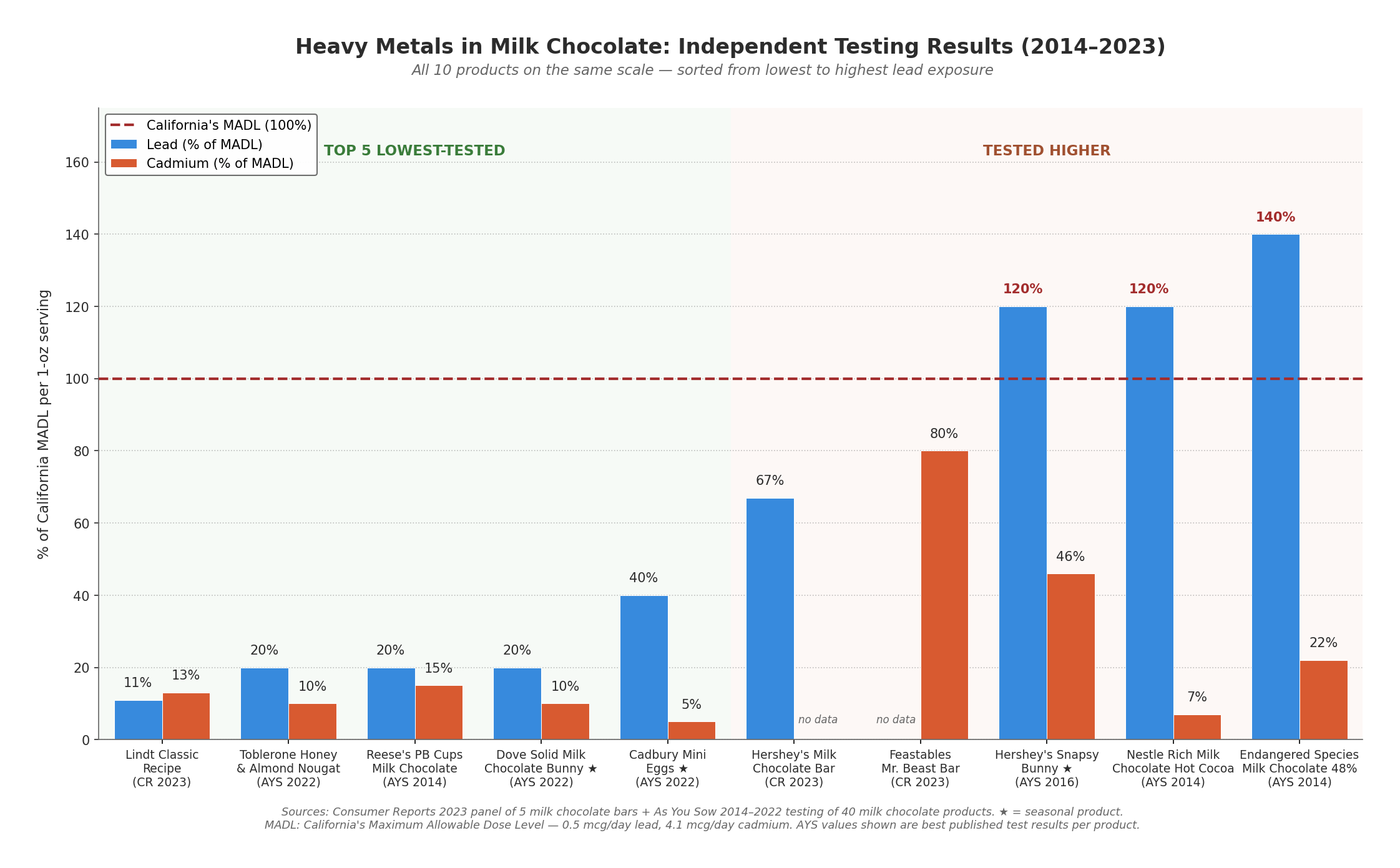
The Top 3: Year-Round Milk Chocolate That Tested Lowest
For everyday or regular consumption, the three milk chocolate products below have the strongest combination of low test results plus year-round availability:
| Product | Lead | Cadmium | Source |
|---|---|---|---|
| Lindt Classic Recipe Milk Chocolate Bar | 11% MADL | 13% MADL | CR 2023 |
| Toblerone Milk Chocolate with Honey & Almond Nougat | 20% MADL | 10% MADL | AYS 2022 |
| Reese’s Milk Chocolate Peanut Butter Cups | 20% MADL | 15% MADL | AYS 2014 |
Lindt Classic Recipe Milk Chocolate tested lowest of all 5 milk chocolate bars in Consumer Reports’ 2023 panel, with both lead and cadmium values comfortably below MADL. Its widespread availability in standard grocery stores makes it the most accessible everyday choice.
Toblerone Milk Chocolate with Honey & Almond Nougat appeared in As You Sow’s testing across multiple years (testing dates in 2022) with consistently low results. The triangular Swiss-style bar is widely available at grocery stores and pharmacies.
Reese’s Milk Chocolate Peanut Butter Cups tested at low levels in As You Sow’s 2014 testing. Different Reese’s products and test years showed some variation in cadmium values; the standard Milk Chocolate Peanut Butter Cup has been the most consistent low-tested option in the line.
Bonus: 2 Seasonal Milk Chocolate Options That Also Tested Low
Beyond the year-round Top 3, two seasonal Easter products also tested well below MADL in As You Sow’s 2022 testing. They’re worth knowing about if you buy candy during the spring holiday window or are planning Easter baskets:
| Product | Lead | Cadmium | Source | Season |
|---|---|---|---|---|
| Dove Solid Milk Chocolate Bunny | 20% MADL | 10% MADL | AYS 2022 | Easter |
| Cadbury Mini Eggs Milk Chocolate | 40% MADL | 5% MADL | AYS 2022 | Easter |
Both products tested well below MADL for both lead and cadmium. Dove Solid Milk Chocolate Bunny matched Toblerone’s 20% lead / 10% cadmium results in AYS’s 2022 testing—making it a strong seasonal pick. Cadbury Mini Eggs tested slightly higher for lead at 40% but had the lowest cadmium reading in the entire dataset (5%). Note that seasonal products are tested less frequently than year-round products and may have different sourcing across batches; the values shown reflect the specific 2022 production runs AYS tested.
A note on testing data variability: AYS values shown here represent the best published test results per product across multiple test runs where available. Some products have been tested multiple times across different years; values may differ slightly between batches. Testing data reflects the production runs that were tested and is not a guarantee of current product composition.
Milk Chocolate Products That Exceeded California's Lead and Cadmium Limit
While most milk chocolate products in independent testing meet California’s MADL, several specific products tested notably higher and warrant attention from regular consumers:
The 3 Products That Exceeded the Lead Limit
Three milk chocolate products in As You Sow’s testing exceeded California’s MADL on a per-serving basis—all three for lead specifically (cadmium values stayed below MADL for each):
| Product | Lead | Cadmium | Source |
|---|---|---|---|
| Endangered Species Natural Milk Chocolate 48% | 140% | 22% | AYS 2014 |
| Hershey’s Solid Milk Chocolate Snapsy Bunny (seasonal) | 120% | 46% | AYS 2016 |
| Nestlé Rich Milk Chocolate Flavor Hot Cocoa Mix | 120% | 7% | AYS 2014 |
Note: Nestlé Rich Milk Chocolate Flavor Hot Cocoa Mix is a hot cocoa beverage mix rather than a chocolate bar, but is included here because As You Sow’s public dataset categorizes it as a milk chocolate product. Per-serving values reflect the prepared beverage as labeled on the product packaging.
For the Endangered Species product, this finding is notable because the brand markets itself around environmental and ethical sourcing—reinforcing the broader pattern that organic, natural, or ethically-marketed certifications do not predict lower heavy metal content. The 2024 peer-reviewed study by Hands et al. in Frontiers in Nutrition found that organic chocolate products averaged slightly higher levels of heavy metals than non-organic across their multi-year analysis.
2 Products That Tested High but Didn’t Exceed the Limit
Two products from Consumer Reports’ 2023 milk chocolate panel did not exceed MADL but tested noticeably higher than other products in their category:
| Product | Lead | Cadmium | Source |
|---|---|---|---|
| Hershey’s Milk Chocolate Bar | 67% MADL | below MADL | CR 2023 |
| Feastables Mr. Beast Milk Chocolate Bar | below MADL | 80% MADL | CR 2023 |
For people consuming milk chocolate occasionally (a few times per month), these products are not a particular concern. For daily or near-daily consumers, the lower-tested options in the Top 3 year-round list above provide significantly more margin from MADL.
As You Sow maintains an ongoing milk chocolate testing tracker that may include more recent results than the public datasets shown here. For brand-specific testing not in either dataset, request a Certificate of Analysis from the manufacturer with per-serving values measured in micrograms.
How to Choose Lower-Metal Milk Chocolate at the Store
Milk chocolate testing across both Consumer Reports and As You Sow shows a generally encouraging picture: the substantial majority of milk chocolate products fall below California’s MADL on a per-serving basis. But brand selection still matters meaningfully, and the few products that exceeded MADL in independent testing are not always the ones you might expect. Here’s how to translate the testing data into practical shopping decisions.
7 Practical Ways to Choose Lower-Exposure Milk Chocolate
- Default to the Top 3 year-round products for everyday consumption. Lindt Classic Recipe, Toblerone Honey & Almond Nougat, and Reese’s Milk Chocolate Peanut Butter Cups all tested well below MADL across multiple test runs. For seasonal Easter products, Dove Solid Milk Chocolate Bunny and Cadbury Mini Eggs also tested well. For daily or near-daily milk chocolate consumers, choosing from these lists is the highest-impact shopping decision.
- Be cautious with Endangered Species Natural Milk Chocolate 48%, Hershey’s Solid Milk Chocolate Snapsy Bunny, and Nestlé Rich Milk Chocolate Flavor Hot Cocoa Mix. These three products exceeded MADL for lead in As You Sow’s testing. While AYS testing reflects specific production runs and conditions may have changed, these products warrant extra scrutiny if you buy them regularly.
- Don’t assume organic equals lower heavy metals. Endangered Species 48% markets itself around environmental and ethical sourcing but tested at 140% of the lead MADL. The 2024 study by Hands et al. in Frontiers in Nutrition found organic chocolate products averaged slightly higher heavy metals than non-organic.
- Check As You Sow’s database for milk chocolate brands not covered above. Since 2014, the nonprofit As You Sow has independently tested over 469 chocolate products at state-certified laboratories—covering dark chocolate, milk chocolate, and cocoa-based products—finding that 285 of them (roughly 61%) contained lead and/or cadmium above California’s MADL on a per-serving basis. The 40 milk chocolate products in this dataset are searchable by brand.
- Request a Certificate of Analysis from brands you buy regularly. Ask for per-serving values in micrograms, not ppm or percentage-of-settlement-threshold. The latter obscures the MADL comparison.
- Be especially careful with seasonal products. Easter, Halloween, and other holiday-only products are tested less frequently and may have different sourcing. Two of the three milk chocolate products that exceeded MADL in AYS testing were seasonal products (Hershey’s Snapsy Bunny is seasonal; the Endangered Species and Nestlé products are year-round).
- Think about your total dietary picture. Spinach, sweet potatoes, peanut butter, leafy greens, and root vegetables also contribute to daily lead and cadmium intake. Your milk chocolate choices matter in proportion to how often you eat it.
What to Ask Any Milk Chocolate Brand Directly
If you want to evaluate a specific milk chocolate brand that isn’t in CR’s panel or AYS’s database—a boutique chocolate maker, a holiday product, a gift—these are the questions to ask by email:
- “Can you provide a Certificate of Analysis for lead and cadmium in micrograms per serving?” Per-serving micrograms is the only unit that lets you compare directly to the MADL.
- “How do your current levels compare to California’s MADL, not just to the As You Sow settlement thresholds?” Many brands volunteer only settlement-compliance claims, which can obscure MADL performance.
- “How often do you test, and is testing done by an independent third-party lab?” Independent, frequent testing is the standard that matters most.
- “Where does your cocoa come from, and do you blend beans from multiple origins?” Blending lowers cadmium; single-origin sourcing from high-cadmium regions tends to concentrate it.
- “How consistent have your results been across the past three years?” Consistent favorable testing is stronger evidence than a single reassuring report.
Special Situations: Young Children, Daily Consumption, Holidays
Some readers need to weigh these findings differently based on their life stage or consumption patterns. Here's how to think about the categories that warrant extra attention.
For Families With Young Children
Children are more vulnerable to lead and cadmium than adults because their developing brains and nervous systems absorb more of these metals per pound of body weight, and because cumulative exposure during childhood has been associated with learning disabilities and reduced cognitive function (Ciesielski et al., 2012). The FDA’s Interim Reference Level for lead is 2.2 micrograms per day for children and 8.8 micrograms per day for women of childbearing age (FDA, 2022).
Milk chocolate is a relatively low-concern category for occasional treats. For kids eating milk chocolate products regularly, choosing from the Top 3 year-round list (Lindt Classic Recipe, Toblerone Honey & Almond Nougat, Reese’s Milk Chocolate Peanut Butter Cups) matters more than for occasional consumers. Avoid the three milk chocolate products that exceeded MADL in As You Sow’s testing (Endangered Species Natural Milk Chocolate 48%, Hershey’s Solid Milk Chocolate Snapsy Bunny, and Nestlé Rich Milk Chocolate Flavor Hot Cocoa Mix) for any product consumed by children regularly.
For parents, the reassuring part is that none of this requires overhauling your home overnight—small, science-informed changes, made one at a time, add up to meaningful reductions in cumulative exposure. The free Ultimate Home Detox™ Kickstart Series is a welcoming introduction to that approach and an easy first step into Ruan Living.
For Daily Milk Chocolate Eaters
If a piece of milk chocolate is part of your daily routine, the brand you pick matters more than it does for occasional eaters. Because all five milk chocolate bars in CR's panel tested below MADL, the category is generally reassuring—but Hershey's Milk Chocolate bar reached 67% of MADL for lead, which is meaningful if you're eating multiple servings or combining with other chocolate products. Consider rotating brands, varying forms (one day a milk chocolate square, another day none), and pairing with iron-, calcium-, and zinc-rich foods, which can reduce absorption of lead.
For Holiday Seasons (Halloween, Easter, Valentine’s Day)
Holiday candy is one of the few times of year most families consume meaningfully more chocolate than usual. For a short, defined period—a week of Halloween candy, an Easter basket, a Valentine’s Day treat—one or two days of elevated consumption isn’t a long-term cumulative concern in the way daily consumption would be.
A few practical adjustments help: for Easter, Dove Solid Milk Chocolate Bunny and Cadbury Mini Eggs Milk Chocolate are the lowest-tested seasonal options in As You Sow’s data. Avoid Hershey’s Solid Milk Chocolate Snapsy Bunny, which exceeded MADL for lead in AYS testing. For year-round candy bowls and gift exchanges, default to the Top 3 year-round products (Lindt Classic Recipe, Toblerone Honey & Almond Nougat, and Reese’s Peanut Butter Cups).
Sophia’s Perspective
My family indulges in milk chocolate occasionally—a small square on its own, or shaved over a smoothie or homemade ice cream. For those moments I keep Lindt Classic Recipe Milk Chocolate in the pantry, the bar that tested lowest in Consumer Reports’ 2023 panel. My kids also bake with chocolate chips—in pancakes and cookies—so I stock 365 Whole Foods Market Semi-Sweet Chocolate Baking Chips, which Consumer Reports named among the chocolate chips relatively low in both lead and cadmium; as CR notes, a chip serving is only about a half-ounce, so I keep the portions modest. For holiday baking I reach for Navitas Organics Organic Cacao Powder, and when we want hot cocoa I make it from that same cacao powder with warm milk rather than a pre-mixed product—the pre-mixed hot cocoa mixes were among the highest-tested in this category. None of this is about perfection. It’s about knowing the few products I reach for most often and choosing the lower-tested option in each.
The Big Brand Question: Hershey’s, Mars, and Nestlé
Three companies dominate American milk chocolate: Hershey’s, Mars (owner of Dove, M&M’s, Snickers, and others), and Nestlé (owner of Kit Kat in the U.S.). These brands are in most candy aisles. Here’s what public independent testing tells us about each company’s milk chocolate products specifically.
Hershey’s (Milk Chocolate Bar, Snapsy Bunny)
Hershey’s milk chocolate has appeared in both major independent testing programs:
- Hershey’s Milk Chocolate Bar: Tested at 67% of MADL for lead in CR’s 2023 panel—the highest lead level among the five milk chocolate bars tested, but still below the threshold. (For context, the lowest-lead milk chocolate bar in the same panel, Lindt Classic Recipe, came in at 11%.)
- Hershey’s Solid Milk Chocolate Snapsy Bunny: The seasonal Easter product exceeded MADL for lead at 120% per serving in As You Sow’s 2016 testing.
In May 2023, Consumer Reports delivered more than 75,000 consumer petition signatures to Hershey’s urging firm, time-bound commitments to reduce heavy metals in its chocolate products. In public statements, Hershey’s CFO told Reuters the company “continues to look for opportunities” to reduce levels, but no firm commitments have been announced. For shoppers, Hershey’s standard milk chocolate bars are within MADL as of CR’s most recent testing, but the seasonal Snapsy Bunny exceeded MADL and the broader Hershey’s portfolio (including dark chocolate and cocoa products) has had notable exceedances. For dark chocolate Hershey’s testing context, see our Heavy Metals in Dark Chocolate guide.
Mars (Dove, M&M’s, Snickers, Milky Way)
Mars Wrigley products were not in Consumer Reports’ 2023 milk chocolate bar panel. As You Sow’s testing of Dove Solid Milk Chocolate Bunny (seasonal, 2022) found this product among the lowest-tested milk chocolate options at 20% of the lead MADL and 10% of the cadmium MADL per serving—making it one of Mars’s strongest documented milk chocolate options. M&M’s, Snickers, and Milky Way have not been included in published independent testing panels for milk chocolate.
Mars publicly states that all its products comply with applicable food safety regulations. The company has not published comprehensive testing data for its broader milk chocolate portfolio. If you consume Mars milk chocolate products regularly and want heavy metal transparency, contact Mars Consumer Affairs and request Certificates of Analysis for per-serving lead and cadmium values.
Nestlé (Kit Kat, Crunch, Rich Milk Chocolate Hot Cocoa)
Nestlé’s milk chocolate products have appeared in independent testing primarily through As You Sow’s database:
- Nestlé Rich Milk Chocolate Flavor Hot Cocoa Mix: Exceeded MADL for lead at 120% per serving in AYS’s 2014 testing. (Note: this is a hot cocoa beverage mix, but As You Sow’s public dataset categorizes it as a milk chocolate product.)
Nestlé’s standard milk chocolate bar products (Kit Kat, Crunch) have not been included in Consumer Reports’ 2023 milk chocolate bar panel or extensively in As You Sow’s milk chocolate testing. Nestlé’s public response to CR was that the company applies “strict standards” and works with suppliers to “monitor and minimize the presence of these substances.” For shoppers, the Rich Milk Chocolate Flavor Hot Cocoa Mix is the Nestlé milk chocolate product with the strongest documented MADL concern. For dark chocolate, chips, cocoa powder, and other cocoa-containing Nestlé products, see our Heavy Metals in Dark Chocolate guide.
The Industry’s Position: What It Means for Shoppers
The National Confectioners Association—the trade group that represents Hershey’s, Mars, Nestlé, and other major chocolate manufacturers—has maintained throughout CR’s testing cycles that chocolate and cocoa are “safe to eat and can be enjoyed as treats, as they have been for centuries.” The NCA argues that Consumer Reports’ use of California’s MADL is inappropriate because the MADL is not a food safety standard—it’s a reproductive toxicity reference level. The NCA points instead to the 2018 As You Sow settlement thresholds, which the industry agreed to but which are substantially less stringent than the MADL. Consumer Reports and As You Sow continue to measure published testing against the MADL because it represents the toxicological benchmark—the point at which reproductive harm begins to appear, divided by 1,000 for safety margin—rather than the negotiated industry threshold.
The upshot for shoppers: brand claims of “Prop 65 compliant” usually mean settlement-compliant, not MADL-compliant. Interpreting those claims requires knowing which threshold is being referenced.
The Science: Why Heavy Metals End Up in Milk Chocolate
Lead and cadmium concentrate in the cocoa solids of chocolate. Milk chocolate typically contains 10-40% cacao, so the amount of cocoa solids per serving is modest—which keeps per-serving metal levels proportionally modest as well.
The two metals enter cocoa through different pathways. Cadmium is absorbed from the soil by cacao tree roots during growth; concentrations depend on geography, with volcanic and phosphate-rich soils in parts of Central and South America tending to produce higher-cadmium beans than those from West Africa, Madagascar, and the Dominican Republic. Lead is deposited after harvest, during fermentation and drying, when beans are often laid out on tarps or directly on the ground and lead-containing dust settles on their sticky surfaces.
This distinction matters because reducing lead contamination is achievable within a single growing cycle through improved post-harvest handling, while reducing cadmium requires longer-term strategies like blending beans from different origins, selective breeding, and soil remediation. When you see a brand claim that they're working to reduce heavy metals, understanding which metal they're addressing tells you how quickly they can deliver results.
Why Even Low Levels Matter
The CDC has stated that no safe blood lead level has been identified in children. A 2012 analysis of U.S. NHANES data found that American children in the highest quartile of urinary cadmium had approximately three times the odds of parent-reported learning disabilities and special education utilization compared with those in the lowest quartile (Ciesielski et al., 2012). A 2025 systematic review in Toxics analyzed 68 studies covering heavy metals and early-life neurodevelopment across 215,195 individuals in 23 countries. A single ounce of milk chocolate will not cause acute toxicity in a healthy adult—the concern is chronic, cumulative exposure, especially when milk chocolate consumption is regular or combined with other dietary lead and cadmium sources over time.
If you're weighing milk chocolate against dark chocolate as a category choice (considering both heavy metals and nutritional trade-offs like flavanols and sugar), see our research-informed comparison of dark and milk chocolate.
How to Read Heavy Metals Testing Numbers
When Consumer Reports, As You Sow, and independent labs report heavy metals findings, they use three measurement approaches. Understanding each one lets you translate any testing result into an apples-to-apples comparison.
- Parts per million (ppm) or micrograms per gram (mcg/g)—measures concentration.
- Micrograms per serving (mcg/serving)—concentration multiplied by serving size.
- Percentage of MADL—what Consumer Reports publishes. Micrograms-per-serving divided by California's Maximum Allowable Dose Level (0.5 mcg/day lead, 4.1 mcg/day cadmium).
For a plain-language explanation of what California's Proposition 65 is, how MADLs are calculated, what "Prop 65 compliant" actually tells you when a brand makes that claim, and the current federal regulatory picture, see the companion dark chocolate post's FAQ section.
What About Chocolate Chips, Hot Cocoa, and Baking Mixes?
For many families—likely including yours if you bake or make hot cocoa—chips, cocoa powder, hot cocoa mixes, and brownie or cake mixes account for more of the chocolate in the house than milk chocolate bars do. Here is where they fit: because lead and cadmium concentrate in cocoa solids, these products are generally more cocoa-dense than milk chocolate and behave more like dark chocolate in testing. Consumer Reports’ 2023 panel tested all of them, and the detailed product-by-product results live in our Heavy Metals in Dark Chocolate guide. Here is what that means for each, and where the milk-chocolate-specific data is thin.
Chocolate chips. Most chocolate chips sold in the U.S. are semi-sweet or dark—roughly 60–70% cacao—rather than milk chocolate. The chips Consumer Reports tested, both the lower-tested options and the two that exceeded the lead MADL, were semi-sweet or dark products, so there is very little milk-chocolate-chip-specific testing data to report. If you bake with chips, the lowest-tested options (which happen to be semi-sweet) and the full results are in the dark chocolate guide.
Hot cocoa mixes. This is the one category here with genuine milk-chocolate-specific data, and it is cautionary. Hot cocoa was the worst-performing category in CR’s 2023 testing, with four of six mixes exceeding the lead MADL. Two of those were explicitly milk-chocolate-flavor products: Great Value Milk Chocolate Flavor, and the Nestlé Rich Milk Chocolate Flavor mix already noted in the exceeded-MADL table above. If hot cocoa is part of your routine, a practical alternative many families prefer is making it from a lower-tested cocoa powder with warm milk rather than a pre-mixed product, which also lets you control the serving size.
Cocoa powder and baking mixes. Cocoa powder is essentially pure cocoa solids, and most brownie and cake mixes are built around it, so these are dark-leaning by composition with no meaningful milk-chocolate equivalent. They tested higher per gram in CR’s panel, with a serving-size catch worth knowing: a single baked portion can concentrate several servings’ worth of cocoa powder. The lower-tested picks and full results are in the dark chocolate guide.
Frequently Asked Questions About Milk Chocolate and Heavy Metals
Is milk chocolate safe to eat?
For most healthy adults, an occasional ounce of milk chocolate is not associated with acute risk. The concern is chronic, cumulative exposure—particularly for children, who tend to eat more milk chocolate than adults and whose developing brains are more vulnerable to lead and cadmium. Choosing brands with lower-tested heavy metals levels meaningfully reduces cumulative exposure. Across Consumer Reports’ 2023 panel of 5 milk chocolate bars and As You Sow’s testing of 40 milk chocolate products, the substantial majority tested below California’s Maximum Allowable Dose Level (MADL) for both lead and cadmium per serving, but exceedances do occur and brand selection matters.
Which milk chocolate brand has the lowest heavy metals?
Lindt Classic Recipe Milk Chocolate measured the lowest in Consumer Reports’ 2023 panel: 11% of California’s MADL for lead and 13% for cadmium per one-ounce serving. As You Sow’s independent testing also identified consistently low results for Toblerone Milk Chocolate with Honey & Almond Nougat, Reese’s Milk Chocolate Peanut Butter Cups, Dove Solid Milk Chocolate Bunny (seasonal), and Cadbury Mini Eggs Milk Chocolate (seasonal). Together these year-round and seasonal options represent the strongest published low-contamination test results across both major independent testing programs.
Should I avoid Hershey’s milk chocolate?
Hershey’s Milk Chocolate Bar measured at 67% of California’s MADL for lead in Consumer Reports’ 2023 panel—the highest lead value among the 5 milk chocolate bars CR tested, but still below the MADL threshold. As You Sow’s separate testing of Hershey’s Solid Milk Chocolate Snapsy Bunny (a seasonal Easter product, tested in 2016) found the product exceeded MADL for lead at 120% per serving. For everyday milk chocolate consumption, Hershey’s standard milk chocolate bars are below MADL on a per-serving basis. For products with consistently lower lead levels, Lindt Classic Recipe and the AYS-tested low-contamination products listed above are stronger choices.
Is Lindt milk chocolate safe?
Lindt Classic Recipe Milk Chocolate tested lowest of all 5 milk chocolate bars in Consumer Reports’ 2023 panel, at 11% of MADL for lead and 13% for cadmium. Lindt has not publicly committed to ongoing third-party heavy metals reporting, but its milk chocolate measured well below MADL in the most recent independent testing. Note that Lindt’s dark chocolate line (Lindt Excellence Dark) performed differently in independent testing—Lindt Excellence Dark Chocolate 70% exceeded California’s MADL for cadmium in CR’s 2022 dark chocolate panel.
Are M&M’s, Dove, and Snickers safe?
Mars Wrigley products (M&M’s, Dove, Snickers, Twix, etc.) were not in Consumer Reports’ 2023 milk chocolate panel. As You Sow’s testing of Dove Solid Milk Chocolate Bunny (seasonal, 2022 testing) found the product among the lowest-tested milk chocolate products, at 20% of MADL for lead and 10% for cadmium. Mars Wrigley publicly states that all of its products comply with applicable food safety regulations, including in California. As of June 2026, Mars has not published comprehensive product-by-product heavy metals testing data for its broader chocolate portfolio. For the highest confidence in low-contamination milk chocolate, the products listed in the Top 3 year-round section above are the strongest documented choices.
Is organic milk chocolate lower in heavy metals?
No. The 2024 peer-reviewed study by Hands et al. in Frontiers in Nutrition found that organic chocolate products averaged slightly higher levels of heavy metals than non-organic products. As You Sow’s testing of the organic Endangered Species Natural Milk Chocolate 48% found this product exceeded MADL for lead at 140% per serving—the highest lead exceedance in the AYS milk chocolate dataset. Organic certification is valuable for avoiding synthetic pesticides, but it does not predict lower heavy metal content.
How much milk chocolate is safe per day?
Healthy adults choosing from the lowest-tested milk chocolate products can reasonably enjoy a half-ounce to one ounce most days. Children should consume smaller portions, and parents may want to rotate among the lowest-tested products rather than relying on a single brand—particularly for products consumed regularly. For daily consumers, choosing Lindt Classic Recipe Milk Chocolate or another below-MADL product makes a meaningful difference in cumulative exposure compared with frequently consuming products that exceeded MADL in independent testing.
Is milk chocolate safe during pregnancy?
You do not need to eliminate milk chocolate during pregnancy, but minimizing exposure to lead and cadmium is a reasonable precaution because both metals can cross the placenta. Lindt Classic Recipe Milk Chocolate’s 11% lead MADL result represents the strongest documented low-exposure milk chocolate option from CR’s 2023 panel. Limit portions to a half-ounce or less, do not eat milk chocolate daily, and discuss specific concerns with your obstetrician or a registered dietitian familiar with prenatal nutrition.
Is milk chocolate lower in heavy metals than dark chocolate?
Generally yes. Because lead and cadmium concentrate in cocoa solids, milk chocolate—which contains less cocoa than dark chocolate—typically contains lower levels of both metals per serving. In Consumer Reports’ 2023 panel, every milk chocolate bar tested came in below MADL for both metals in a one-ounce serving, while CR’s 2022 dark chocolate panel found 23 of 28 bars exceeded MADL for at least one metal. That said, milk chocolate carries different nutritional considerations: substantially more sugar, fewer antioxidants, and less of the cardiovascular benefit attributed to dark chocolate flavanols. For a side-by-side comparison, see our companion guide: Dark Chocolate vs. Milk Chocolate.
What do Hershey’s, Mars, and Nestlé say about heavy metals in their chocolate?
All three companies publicly state that their products comply with applicable food safety regulations. Hershey’s stated in 2022 that lead and cadmium in chocolate are present at very low levels and that the company is working with suppliers to find ways to further reduce them. Mars and Nestlé have made similar compliance-focused statements. Industry compliance under California’s Proposition 65 typically refers to the 2018 As You Sow v. Trader Joe’s Company consent judgment thresholds (which are less stringent than the underlying MADL on a per-serving basis), not the MADL itself. For shoppers who want the strongest documented low-exposure assurance, the products listed in the Top 3 year-round section provide that evidence base.
Is there a federal U.S. standard for lead in milk chocolate?
As of June 2026, no. There is no federal U.S. standard that sets maximum levels of lead or cadmium in chocolate specifically. The FDA’s Closer to Zero action plan (launched April 2021) is developing action levels for foods consumed by babies and young children, but chocolate-specific standards have not been finalized. In January 2025, the FDA issued final guidance on lead action levels for processed foods intended for children under two, but these are guidelines rather than binding regulations. California’s Proposition 65 MADL (0.5 mcg/day for lead, 4.1 mcg/day for cadmium) remains the strictest publicly available U.S. reference level for evaluating chocolate.
Where can I find independent testing data for specific milk chocolate brands?
Two independent testing programs publish comprehensive milk chocolate data. Consumer Reports’ 2023 chocolate testing panel included 5 milk chocolate bars (with full lead and cadmium values published for some products). As You Sow’s Toxic Chocolate database has tracked milk chocolate products since 2014, with 40 milk chocolate products tested in their dataset. The As You Sow ongoing tracker is publicly searchable at asyousow.org. For brand-specific testing not in either dataset, request a Certificate of Analysis from the manufacturer with per-serving values measured in micrograms (not just ppm concentration), and check those numbers against the MADL.
The Bottom Line on Milk Chocolate and Heavy Metals
Milk chocolate presents a generally lower-concern heavy metals profile than dark chocolate. Across Consumer Reports’ 2023 panel of 5 milk chocolate bars and As You Sow’s 2014–2022 testing of 40 milk chocolate products, the substantial majority tested below California’s MADL on a per-serving basis. Only 3 milk chocolate products exceeded MADL in the combined dataset—all three for lead specifically, with cadmium staying below MADL across the entire dataset.
For everyday milk chocolate consumers, the practical guidance is straightforward. Lindt Classic Recipe Milk Chocolate tested lowest in CR’s 2023 panel at 11% of MADL for lead and 13% for cadmium—a meaningful margin of safety. Combined with Toblerone Milk Chocolate with Honey & Almond Nougat and Reese’s Milk Chocolate Peanut Butter Cups from As You Sow’s testing, these three year-round products form a strong default choice list. For seasonal candy, Dove Solid Milk Chocolate Bunny and Cadbury Mini Eggs Milk Chocolate were the lowest-tested Easter options in independent testing.
The three milk chocolate products that exceeded MADL warrant extra scrutiny if you buy them regularly: Endangered Species Natural Milk Chocolate 48% (140% lead MADL), Hershey’s Solid Milk Chocolate Snapsy Bunny (120% lead, seasonal), and Nestlé Rich Milk Chocolate Flavor Hot Cocoa Mix (120% lead). These results reflect the production runs and conditions tested; current product composition may have changed.
The most practical lever you have is the same one in any nontoxic living decision: within the milk chocolate products you consume regularly, choose the ones with the best available testing data. You don’t have to choose between milk chocolate and peace of mind. You just need to know which specific products deserve which kind of attention.
What Else Are You Exposed To Every Day?
If learning about heavy metals in chocolate changed the way you look at your diet, you'll be surprised by what else may be contributing to your everyday toxic exposures.
Join Sophia Ruan Gushée's free Ultimate Home Detox Kickstart Series and learn practical ways to reduce exposures from cleaning products, forever chemicals (PFAS), cookware, personal care products, and more—one simple step at a time.
Get Instant Access →Still Wondering Whether Dark or Milk Chocolate Is Better?
Heavy metals are only part of the equation. Compare dark chocolate and milk chocolate side-by-side, including lead, cadmium, antioxidants, flavanols, sugar, and overall health considerations.
Read the Comparison Guide →About the Author
Sophia Ruan Gushée is a citizen researcher, author, and mother of three whose work has investigated everyday environmental exposures for nearly two decades, with a particular focus on reproductive health, pregnancy outcomes, prenatal development, and healthspan. She is the founder of Ruan Living and the creator of Practical Nontoxic Living™—a research-grounded framework for reducing toxic exposures that respects the time, attention, and constraints of real families.
Sophia is the author of A to Z of D-Toxing: The Ultimate Guide to Reducing Our Toxic Exposures (2015) and the EMF Detox Workbook. Her books have been endorsed by Frank Lipman, MD; Karl T. Kelsey, MD, MOH (Brown University School of Public Health); David O. Carpenter, MD (Director, Institute for Health and the Environment, University at Albany School of Public Health); Hooman Yaghoobzadeh, MD (NewYork-Presbyterian / Weill Cornell Medical Center); and Devra Davis, PhD, MPH (founder of the Environmental Health Trust and a lead author of the Intergovernmental Panel on Climate Change, which was awarded the 2007 Nobel Peace Prize). Sophia has served on the Brown University School of Public Health Advisory Council and the Well+Good Council. Her work has been featured on The Dr. Oz Show, in MindBodyGreen, Today, Well+Good, Health, Fast Company, and others.
She holds a bachelor's degree from Brown University and an MBA from Columbia Business School. Before turning her analytical training to environmental and public health research, she spent a decade in institutional distressed investing at Donaldson, Lufkin & Jenrette (later part of Credit Suisse) and ING—a background that shapes the rigorous, research-informed approach that defines Practical Nontoxic Living.
Connect: Practical Nontoxic Living Podcast • Substack • Instagram • LinkedIn
Research Sources and Citations
Primary testing source: Consumer Reports. "A Third of Chocolate Products Are High in Heavy Metals, CR's Tests Find." Oct. 25, 2023. Link
Companion CR investigation: Loria, K. "Lead and Cadmium Could Be in Your Dark Chocolate." Consumer Reports, Dec. 15, 2022 (updated Oct. 25, 2023). Link
CR petition to Hershey's (May 2023): Consumer Reports. "Consumer Reports Urges Hershey's to Get Heavy Metals Out of Chocolate Products." Link
Peer-reviewed research: Ciesielski, T., et al. "Cadmium exposure and neurodevelopmental outcomes in U.S. children." Environmental Health Perspectives, 2012. Hands, J.M., et al. "Heavy metals in dark chocolate and cocoa products: A multi-year analysis." Frontiers in Nutrition, 2024. "Systematic review of heavy metals and early-life neurodevelopment." Toxics, 2025. FDA dietary lead analysis: Gavelek, A., et al. "Lead exposures in older children, women of childbearing age and adults: FDA total diet study 2014-16." Food Additives & Contaminants: Part A, 2020.
Regulatory frameworks: California OEHHA Prop 65 | FDA Closer to Zero | CDC on childhood lead exposure
Corporate accountability and independent testing: As You Sow: Toxic Chocolate Database
Companion posts: Ruan Living. "Heavy Metals in Dark Chocolate: 5 Brands That Tested Lowest (2026 Guide)" (2026). Ruan Living. "Dark Chocolate vs. Milk Chocolate: Which Is Healthier?".
Disclosure: This post contains no paid endorsements, affiliate links, or sponsored content. Brand recommendations are based solely on publicly available third-party laboratory testing data from Consumer Reports, As You Sow, and peer-reviewed research. Practical Nontoxic Living at ruanliving.com has no material business relationship with any of the chocolate or cocoa brands discussed in this post.
Disclaimer: This content is for educational purposes only and does not constitute medical advice. Consumer Reports test results reflect specific production runs at a point in time and may not represent current formulations. Individual health decisions should be made in consultation with qualified healthcare professionals. California's MADL is a reproductive toxicity reference level, not an absolute safety threshold or federal safety standard. "Prop 65 compliant" claims from manufacturers may reference the 2018 As You Sow settlement thresholds rather than the underlying MADL.