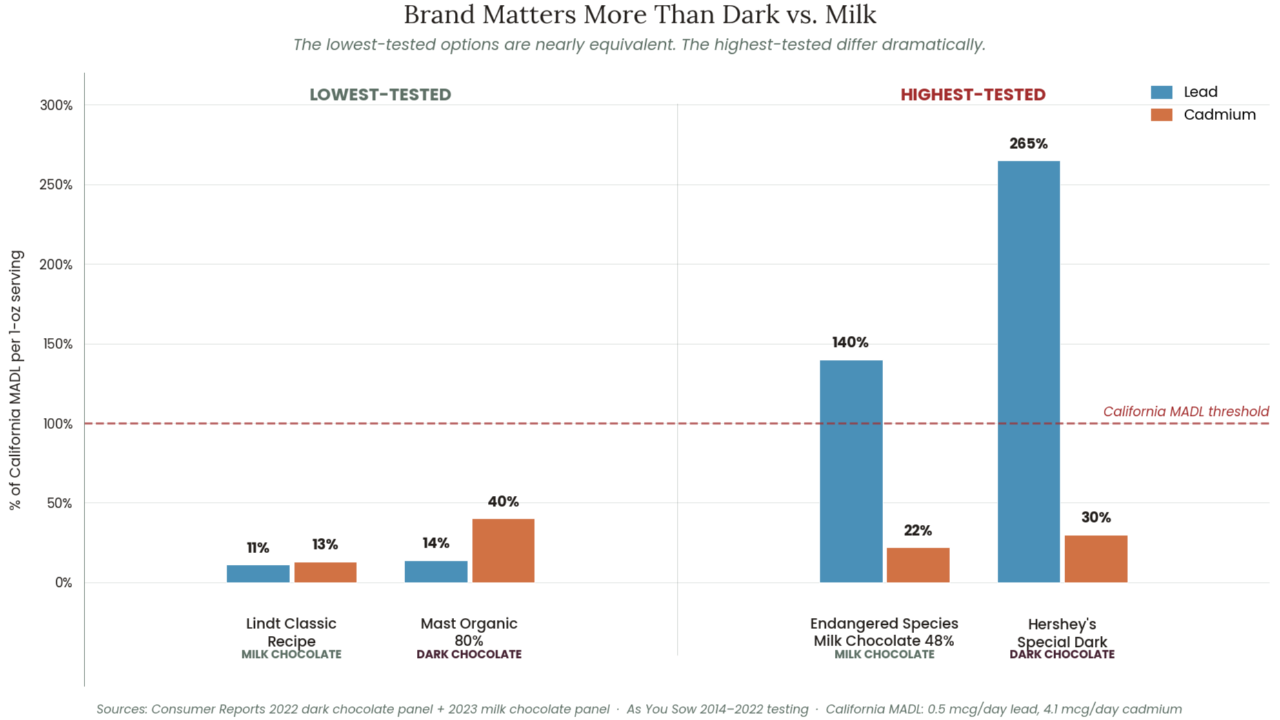
Dark Chocolate vs. Milk Chocolate: Which Is Healthier?
Jun 07, 2026By Sophia Ruan Gushée • Published June 6, 2026 • Based on third-party testing from Consumer Reports and As You Sow, plus peer-reviewed nutrition research
"Dark chocolate delivers genuine cardiovascular benefits—and tests, on average, with roughly two to three times more lead and cadmium per serving than milk chocolate. Milk chocolate has fewer of those metals—but also more sugar, more saturated fat, and few of dark chocolate's flavanol benefits. Here's how to make the right call for your situation."
The 30-Second Answer: Brand Choice Matters More than Category
For most adults eating chocolate a few times per week, dark chocolate from a brand that tested below California's Maximum Allowable Dose Level (MADL) (such as Mast Organic 80% at 14% of the lead MADL) is the best research-informed choice. Dark chocolate provides cardiovascular and metabolic benefits from flavanol antioxidants that milk chocolate largely lacks, with acceptable heavy metals exposure when you choose carefully.
For young children, pregnant readers concerned about cumulative exposure, or people who don't enjoy dark chocolate, milk chocolate from a lower-tested brand (like Lindt Classic Recipe at 11% lead and 13% cadmium MADL) is a reasonable choice. It's the lower-metals category but also the lower-benefits category.
The bigger truth: brand selection within your preferred category often matters more than category selection itself. The best dark chocolate bars tested in the Consumer Reports (CR) panel test lower for heavy metals than the highest-tested milk chocolate bars.
In This Post
- The Two Trade-offs You're Actually Weighing: Benefits vs. Heavy Metals
- What the Research Says About Dark Chocolate's Benefits
- What the Research Says About Milk Chocolate's Nutritional Profile
- The Head-to-Head Heavy Metals Comparison
- Which Is Healthier for You Specifically
- What to Know When You're Shopping for Chocolate
- The Best Dark Chocolate and Best Milk Chocolate Brands
- What About White Chocolate? Lead, Cadmium, and Nutritional Considerations
- How Often Can You Safely Eat Chocolate?
- Frequently Asked Questions About Dark Chocolate vs. Milk Chocolate
- The Bottom Line
The Two Trade-offs You're Actually Weighing: Benefits vs. Heavy Metals
When you're asking "which chocolate is healthiest," you're actually weighing two separate considerations that pull in different directions.
Why Dark Chocolate Has More Lead and Cadmium
Lead and cadmium accumulate in the cocoa solids of chocolate. Dark chocolate contains more cocoa solids than milk chocolate, so it contains more heavy metals per serving on average. This pulls toward milk chocolate as the "safer" choice.
Why Dark Chocolate Has More Cardiovascular Benefits
The flavanol antioxidants in cocoa are responsible for dark chocolate's well-documented cardiovascular benefits. Milk chocolate contains far fewer flavanols because it has less cocoa. Milk chocolate also contains roughly twice the sugar of dark chocolate. This pulls toward dark chocolate as the "healthier" choice.
The best chocolate choice for you depends on how you weigh these two considerations—which depends on your age, life stage, consumption patterns, and individual health priorities. This post gives you the evidence on both axes and then gives specific recommendations for different reader situations.
The research and testing data behind this post come from our two companion guides: Heavy Metals in Dark Chocolate: 5 Brands That Tested Lowest and Heavy Metals in Milk Chocolate: 3 Brands That Tested Lowest. For full methodology, brand-specific shopping lists, and regulatory context on California’s MADL, see those posts directly.
What the Research Says About Dark Chocolate's Benefits
Dark chocolate's health benefits are well-supported by peer-reviewed research, particularly in cardiovascular and metabolic domains. The mechanism is flavanols—a class of polyphenolic antioxidants concentrated in cocoa solids.
Cardiovascular and Metabolic Benefits
A 2016 systematic review and meta-analysis published in the Journal of Nutrition analyzed 19 randomized controlled trials involving 1,131 adult participants. Cocoa flavanol intake significantly improved several cardiometabolic biomarkers:
- Reduced fasting insulin
- Improved insulin sensitivity
- Lower triglycerides
- Higher HDL cholesterol (the "good" cholesterol)
- Lower C-reactive protein, a marker of systemic inflammation
A 2022 meta-analysis of 31 trials published in Nutrients found that two or more weeks of cocoa consumption, whether as a beverage or dark chocolate, was associated with statistically significant reductions in both systolic and diastolic blood pressure. Effects were most pronounced in people with elevated blood pressure at baseline.
Improved Vascular Function and Blood Flow
A 2012 meta-analysis of 42 randomized controlled trials (American Journal of Clinical Nutrition) found improvements in flow-mediated dilation—a measure of how well blood vessels relax and expand to accommodate blood flow—of 1.34% after chronic dark chocolate consumption and 3.19% after acute consumption. Flow-mediated dilation is inversely associated with future cardiovascular events, meaning small percentage improvements translate to measurable risk reduction over time.
The Flavanol Dose That Matters
How much do you actually need? European food-safety regulators set the benchmark for healthy blood flow at about 200 mg of cocoa flavanols a day, and the trials with the strongest results often used more—roughly 500 to 900 mg, usually from standardized cocoa rather than an ordinary chocolate bar. Here's the catch most articles skip: a bar's “% cacao” tells you how much cocoa is in it, not how many flavanols survived. Fermentation, roasting, and the “Dutch” processing that makes cocoa darker and milder all destroy flavanols, so two bars both labeled 70% can differ several times over in what they actually deliver. Dark chocolate is by far the richer source and milk chocolate has very little—but you can't assume any given dark bar gives you a meaningful dose unless its flavanol content has actually been measured and listed.
This is the central reason milk chocolate doesn't produce the same health benefits as dark chocolate in clinical trials: the flavanol dose is too low.
What the Research Says About Milk Chocolate's Nutritional Profile
Milk chocolate has its own distinct profile. It's not "dark chocolate minus benefits"—it's a fundamentally different product with different trade-offs.
Why Milk Chocolate Has Fewer Heavy Metals
Because milk chocolate contains far less cocoa solids than dark chocolate (typically 10-40% cacao versus dark's 55-90%), it contains proportionally less of the lead and cadmium that concentrate in those solids. Consumer Reports' 2023 testing confirmed this pattern: all five milk chocolate bars tested came in below California's MADL for both metals per one-ounce serving. In contrast, 23 of 28 dark chocolate bars in CR's 2022 panel exceeded MADL for at least one metal.
Milk Chocolate's Higher Sugar Load
Milk chocolate typically contains about twice the sugar of dark chocolate. A one-ounce serving of milk chocolate provides 15-25 grams of sugar; the same serving of 70% dark chocolate provides 7-12 grams, and 85% dark chocolate provides 3-6 grams. For readers managing weight, diabetes risk, insulin resistance, or dental health, this difference is clinically meaningful.
Fewer Flavanols, Fewer Documented Benefits
Clinical studies of milk chocolate rarely find the same cardiovascular benefits that dark chocolate produces. The 2016 meta-analysis cited above specifically used cocoa flavanol interventions averaging 166-2,110 mg per day—a range typical milk chocolate consumption cannot reach.
Dairy Fat and Calcium: A Mixed Picture
Milk chocolate contains dairy, which adds calcium, protein, and saturated fat. For readers who tolerate dairy, this provides a modest mineral contribution that dark chocolate lacks. For readers with lactose intolerance, dairy sensitivity, or who follow a dairy-free diet for other reasons, milk chocolate is not an option regardless of its heavy metals profile.
The Head-to-Head Heavy Metals Comparison
The data foundation: Since 2014, the environmental advocacy nonprofit As You Sow has conducted independent laboratory testing of over 469 chocolate products for lead and cadmium at state-certified laboratories—covering dark chocolate, milk chocolate, and cocoa-based products. Of those, 285 products (roughly 61%) contained lead and/or cadmium above California's MADL on a per-serving basis. This cross-category dataset is what makes a genuine "dark vs. milk" comparison possible: we're not comparing two different testing methodologies against each other, we're looking at how two chocolate categories perform when tested the same way. Consumer Reports' 2022 dark chocolate panel (28 bars) and 2023 milk chocolate panel (5 bars) extend that picture with specific per-serving percentages—which is what the chart below displays.
This chart combines Consumer Reports' 2022 dark chocolate testing (the 5 lowest-tested bars from a 28-bar panel) and CR's 2023 milk chocolate testing (the 3 bars publicly identified with specific percentages) on a single scale.
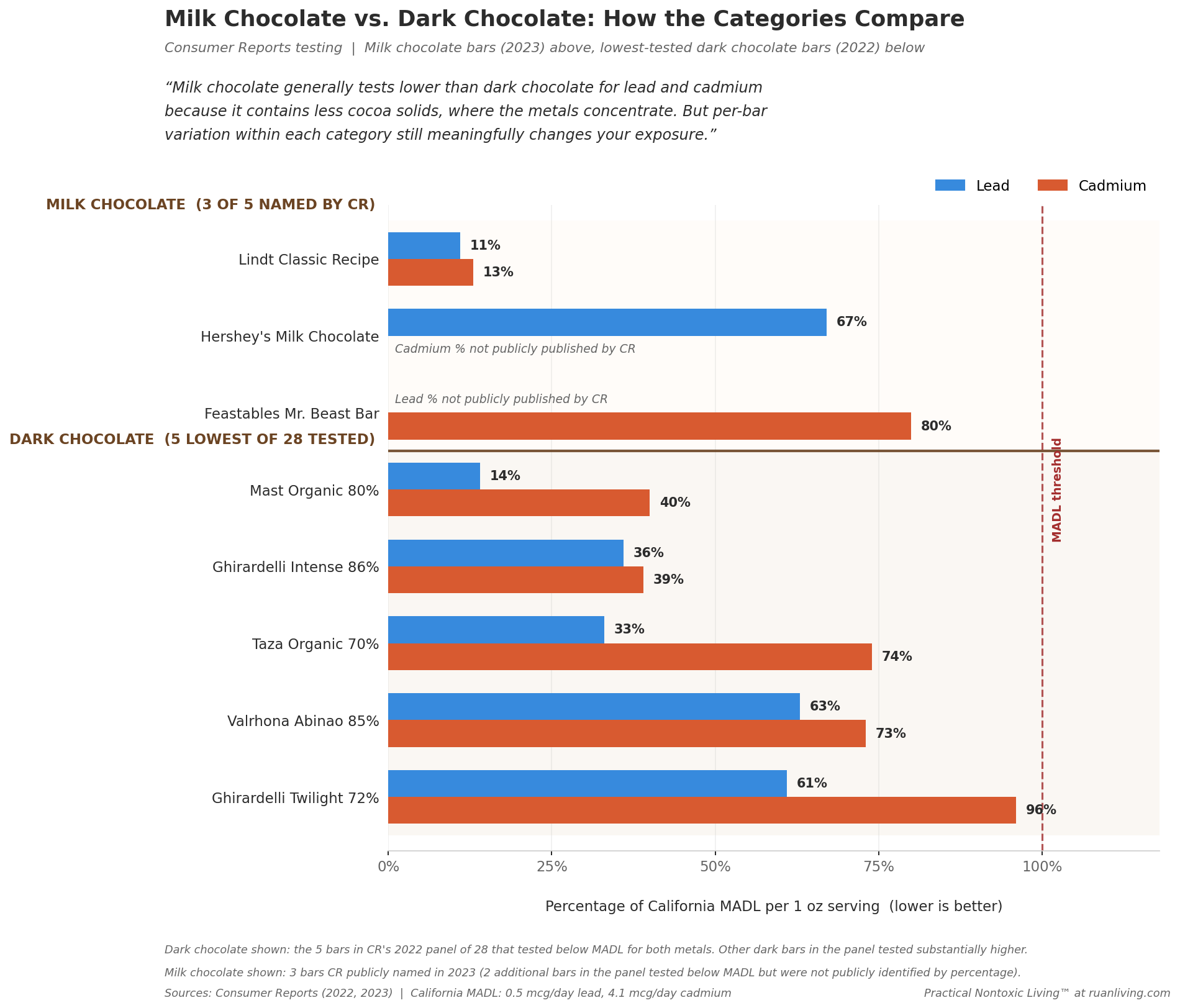
A few observations worth sitting with:
- The lowest-tested chocolate bar overall is a milk chocolate bar. Lindt Classic Recipe Milk Chocolate at 11% lead and 13% cadmium is the lowest-tested product shown in either category.
- But the second-lowest is a dark chocolate bar. Mast Organic 80% at 14% lead and 40% cadmium is within a few percentage points of Lindt for lead and delivers meaningfully more flavanols, but significantly more cadmium.
- Per-bar variation within each category is substantial. Hershey's Milk Chocolate at 67% lead is higher than several dark chocolate bars shown. Feastables at 80% cadmium is higher than all dark chocolate bars in the CR panel except Ghirardelli Twilight at 96%.
- Context for the dark chocolate bars shown: these are the 5 lowest-tested bars from CR's 2022 panel of 28. Other dark chocolate bars in the panel tested as high as 265% of the lead MADL. The broader dark chocolate category runs substantially higher in metals than the 5 bars shown here.
What this chart actually shows: brand selection within each category matters as much as category selection itself. A well-chosen dark chocolate can test nearly as low as the lowest-tested milk chocolate, while a poorly chosen dark chocolate can exceed MADL many times over.
Which Is Healthier for You Specifically
Here are reader-specific recommendations based on the evidence.
For Health-Conscious Adults Who Eat Chocolate a Few Times a Week
Dark chocolate from a brand that tested below MADL. The cardiovascular and metabolic benefits of flavanols are well-documented, and the benchmark for healthy blood flow is roughly 200 mg of cocoa flavanols a day. Mast Organic 80%, Taza Organic 70%, Ghirardelli Intense 86%, and Valrhona Abinao 85% are specific brands CR tested favorably. The lower sugar profile of dark chocolate is an additional benefit for metabolic health.
For Daily Chocolate Eaters
Dark chocolate from the lowest-tested brands, or rotate between dark and milk. A daily chocolate habit means cumulative exposure matters more. Mast Organic 80% at 14% of lead MADL means a daily one-ounce serving uses just 14% of your daily lead reference, leaving margin for other dietary sources.
Rotation strategy: dark chocolate from a low-tested brand most days, occasional milk chocolate from Lindt or a similar low-tested brand to vary sources. This diversifies your risks.
For Pregnant Readers
Either category is acceptable from a low-tested brand, in moderate amounts. Dark chocolate flavanols have been associated with lower preeclampsia risk in some observational research, though later trials have been mixed. Milk chocolate's lower metals profile is a genuine benefit in the other direction. While it's ideal to avoid any ingestion of lead or cadmium, a small daily amount of Mast Organic 80% (or a similar low-tested dark chocolate) or Lindt Classic Recipe Milk Chocolate are both reasonable. Discuss regular consumption with your obstetrician or a registered dietitian familiar with prenatal nutrition.
For Young Children
Milk chocolate, from a low-tested brand, as an occasional treat. Kids are more vulnerable per pound of body weight to heavy metals. The FDA's Interim Reference Level for lead is lower for children (2.2 µg/day) than for women of childbearing age (8.8 µg/day) (FDA, 2022). The cardiovascular benefits of dark chocolate are less relevant for developing children. Lindt Classic Recipe Milk Chocolate (11% lead, 13% cadmium) is a reasonable occasional treat choice. Avoid dark chocolate chips, hot cocoa mixes, and chocolate-flavored supplements for young children without verified third-party testing.
For Readers Managing Diabetes, Insulin Resistance, or Weight
Dark chocolate from a low-tested brand is the stronger choice. Research associates cocoa flavanol intake with improved insulin sensitivity and metabolic markers. Dark chocolate's lower sugar content (especially at 70% cacao and above) provides a secondary metabolic benefit. Milk chocolate's higher sugar can work against these goals.
For Readers Who Genuinely Don't Enjoy Dark Chocolate
Milk chocolate from a low-tested brand beats dark chocolate you don't eat. Dietary adherence matters more than marginal optimization. Occasional milk chocolate from Lindt Classic Recipe or a similar low-tested brand is a perfectly reasonable treat. The health-benefits gap between dark and milk chocolate is real but not so large that forcing yourself to eat a food you dislike makes nutritional sense.
Whichever situation fits you, the same way of weighing benefits against exposures applies well beyond chocolate. The free Ultimate Home Detox™ Kickstart Series is a welcoming introduction to that approach—a short email series and an easy first step into Ruan Living, built on the idea that small, science-informed changes add up to meaningful reductions in cumulative exposure over time.
What to Know When You're Shopping for Chocolate
Translating all of the above into decisions at the shelf—five things worth keeping in mind:
- Choose by testing data, not by “dark vs. milk.” A well-chosen dark bar can test as low for lead and cadmium as the lowest-tested milk chocolate, while a poorly chosen one can test many times higher. The category on the label tells you less than the lab results do.
- Look for brands with third-party testing below California’s MADL. It’s the most useful public benchmark for lead and cadmium per serving—a reproductive-toxicity reference level rather than a federal safety standard, but the best yardstick widely available.
- Don’t read “% cacao” as a health or safety score. A higher cocoa percentage tends to mean more heavy metals (they concentrate in cocoa solids) and tells you nothing reliable about flavanols—two bars both labeled 70% can differ severalfold. Only testing data shows how a specific bar performs.
- Treat concentrated cocoa products with extra care. Cocoa powder, hot cocoa mixes, baking chips, and chocolate-flavored supplements are mostly cocoa solids, so they tend to test higher—choose third-party-tested options, especially for children.
- Match the pick to who’s eating it. For adults who want the cardiovascular upside, a lower-tested dark bar; for young children or during pregnancy, a lower-tested milk chocolate keeps per-serving metals lower.
The Best Dark Chocolate and Best Milk Chocolate Brands
Specific brands from Consumer Reports' testing that represent the lowest-tested options in each category.
Best Dark Chocolate Brands
These five bars tested below California's MADL for both lead and cadmium in a one-ounce serving:
- Mast Organic 80%—14% lead, 40% cadmium. Lowest-lead dark chocolate bar in the CR panel.
- Taza Organic 70%—33% lead, 74% cadmium
- Ghirardelli Intense 86%—36% lead, 39% cadmium
- Ghirardelli Twilight 72%—61% lead, 96% cadmium
- Valrhona Abinao 85%—63% lead, 73% cadmium
For the complete dark chocolate shopping guide with additional brands, shopping tips, and brand transparency analysis, see our dark chocolate heavy metals post.
Best Milk Chocolate Brands
- Lindt Classic Recipe Milk Chocolate—11% lead, 13% cadmium. Lowest-tested milk chocolate bar in the CR panel.
Two additional bars in CR's milk chocolate panel tested below MADL but were not publicly identified by specific percentage. All five milk chocolate bars in the CR panel tested below MADL for both metals. The highest-tested products in CR's panel were Hershey’s Milk Chocolate Bar (67% of MADL for lead) and Feastables Mr. Beast Milk Chocolate Bar (80% of MADL for cadmium)—both still below MADL but a larger share than the lowest-tested options. As You Sow's separate testing of 40 milk chocolate products since 2014 identified additional low-tested options including Toblerone Milk Chocolate with Honey & Almond Nougat and Reese’s Milk Chocolate Peanut Butter Cups.
For the complete milk chocolate shopping guide—including the 3 year-round brands that tested lowest, 2 seasonal options, and 3 milk chocolate products that exceeded MADL—see our Heavy Metals in Milk Chocolate guide. For chocolate chips, cocoa powder, hot cocoa mixes, and baking mixes (which are predominantly made from dark/semi-sweet chocolate), see our Heavy Metals in Dark Chocolate guide.
What About White Chocolate? Lead, Cadmium, and Nutritional Considerations
White chocolate contains no cocoa solids—only cocoa butter, milk, and sugar. On the heavy metals axis, this is genuinely favorable: without cocoa solids, white chocolate has essentially no meaningful lead or cadmium contamination risk.
But on the nutritional axis, white chocolate is worse than either milk or dark chocolate in important ways. A 2026 study published in Metabolism Open compared 15-day consumption of 70% dark chocolate, bloomed dark chocolate, and 0% cocoa (white) chocolate at identical 316-calorie daily servings in 36 healthy adults. The findings:
- Both dark chocolate groups (regular and bloomed) increased total antioxidant capacity, while the white chocolate group showed no such improvement.
- Both dark chocolate groups trended toward lower fasting glucose and higher HDL ("good") cholesterol; the white chocolate group did not.
- White chocolate reduced skin blood flow, a marker of peripheral vascular function—while neither dark chocolate group produced this reduction.
The contrast is meaningful: white chocolate delivers the calories and sugar of chocolate without the cocoa flavanols responsible for dark chocolate's measurable cardiovascular benefits. Its consumption was associated with a measurable reduction in peripheral blood flow in this 15-day intervention.
White chocolate solves the heavy metals problem by removing the beneficial compounds entirely. For most readers, this is a worse trade than either dark or milk chocolate.
How Often Can You Safely Eat Chocolate?
The honest answer depends heavily on brand. Let's do the math for a daily one-ounce serving, using California's MADL of 0.5 µg of lead per day as the reference.
- Daily Mast Organic 80% dark chocolate: 14% of the lead MADL from chocolate alone. Leaves 86% of your daily reference for other sources (spinach, potato chips, peanut butter, etc.). Defensible daily habit.
- Daily Lindt Classic Recipe milk chocolate: 11% of the lead MADL from chocolate. Leaves 89% for other sources. Also a defensible daily habit.
- Daily Hershey's Milk Chocolate bar: 67% of the lead MADL from chocolate alone. Leaves just 33% of your daily reference for everything else. Workable occasionally but tight for a daily habit.
- Daily dark chocolate from a brand that wasn't in CR's lowest-tested panel: potentially 100-265% of MADL per serving. A daily habit of these could exceed MADL several times over from chocolate alone.
The research on cardiovascular benefits generally points to modest daily amounts rather than large ones—and the actual flavanol dose depends heavily on the specific product, since processing reduces it. You don't need large amounts of dark chocolate to get the benefits—you need consistent moderate amounts from a genuinely high-flavanol, lower-tested brand.
Frequently Asked Questions About Dark Chocolate vs. Milk Chocolate
Which is healthier: dark chocolate or milk chocolate?
There's no single answer; it depends on who you are and how often you eat chocolate. For most adults eating chocolate a few times per week, dark chocolate from a brand that tested below California's MADL for lead and cadmium is the best research-informed choice because it provides cardiovascular and metabolic benefits from flavanols that milk chocolate largely lacks, while keeping heavy metal exposure within acceptable margins. For young children, pregnant readers concerned about cumulative exposure, or people who don't enjoy dark chocolate, milk chocolate from a lower-tested brand is a reasonable choice. The practical decision often comes down to brand selection within your preferred category more than category selection itself.
Does dark chocolate have more lead than milk chocolate?
Yes, on average. Dark chocolate contains more cocoa solids than milk chocolate, and lead and cadmium concentrate in the cocoa solids. In Consumer Reports' 2022 testing of 28 dark chocolate bars, 23 exceeded California's MADL for at least one metal. In CR's 2023 testing of five milk chocolate bars, none exceeded MADL for either metal. However, per-bar variation matters: the lowest-tested dark chocolate bars (like Mast Organic 80% at 14% of lead MADL) have lower metals than some milk chocolate bars, and the highest-tested milk chocolate bars approach MADL limits.
Is dark chocolate actually good for you?
Research supports modest cardiovascular and metabolic benefits from flavanol-rich dark chocolate consumption. A 2016 meta-analysis of 19 randomized controlled trials (1,131 participants) published in the Journal of Nutrition found that cocoa flavanol intake significantly improved insulin sensitivity, lipid profile (lower triglycerides, higher HDL), and reduced markers of systemic inflammation. A separate 2012 meta-analysis found flow-mediated dilation improvements of 1.34% after chronic consumption, associated with better vascular health. These benefits are dose-dependent and primarily observed in people with existing cardiovascular risk factors. Milk chocolate contains far lower flavanol content and does not produce comparable benefits in clinical studies.
How much dark chocolate is healthy per day?
Research on cardiovascular benefits points to modest daily amounts of high-flavanol dark chocolate rather than large ones. The benchmark for healthy blood flow is about 200 mg of cocoa flavanols a day, but how much you actually get from a given bar varies widely—processing destroys flavanols, and a bar's “% cacao” doesn't tell you how many are left. However, this recommendation assumes the chocolate comes from a brand that tested below California's MADL for heavy metals. One ounce of a brand like Mast Organic 80% delivers 14% of the daily MADL for lead; one ounce of a higher-contamination brand can exceed 200% of the MADL. The brand you choose matters more than the amount.
Is milk chocolate healthier than dark chocolate for kids?
For young children specifically, milk chocolate is often the more reasonable choice. Kids are more vulnerable per pound of body weight to heavy metals, the FDA's Interim Reference Level for lead is lower for children (2.2 µg/day) than for women of childbearing age (8.8 µg/day), and the cardiovascular benefits of dark chocolate are less relevant for developing children than for aging adults. Milk chocolate from a brand that tested below MADL (like Lindt Classic Recipe, which tested at 11% lead and 13% cadmium in CR's 2023 panel) is a reasonable choice for kids as an occasional treat.
Which has more sugar: dark or milk chocolate?
Milk chocolate typically contains twice the sugar of dark chocolate. A one-ounce serving of milk chocolate contains roughly 15-25 grams of sugar, while the same serving of 70% dark chocolate contains about 7-12 grams, and 85% dark chocolate contains 3-6 grams. For readers managing weight, diabetes risk, or metabolic health, the sugar difference is clinically meaningful and works in favor of dark chocolate even before accounting for flavanol benefits.
Is white chocolate safer or healthier than dark or milk chocolate?
White chocolate contains no cocoa solids—only cocoa butter, milk, and sugar—so it's essentially free of lead and cadmium contamination risk. But it's also free of the flavanols that give dark chocolate its health benefits. A 2026 study published in Metabolism Open found that 15-day consumption of 0% cocoa (white) chocolate reduced skin blood flow and failed to produce the antioxidant capacity increase that both regular and bloomed dark chocolate groups achieved in the same trial. White chocolate avoids the heavy metals question but introduces different concerns.
Should pregnant women eat dark or milk chocolate?
During pregnancy, heavy metal exposure matters more because lead and cadmium can cross the placenta. A small amount of either type of chocolate from a brand that tested below California's MADL is not a significant single-day exposure. Milk chocolate's lower cocoa solids mean lower per-serving metal exposure, which is a genuine advantage during pregnancy. If you want the cardiovascular benefits of dark chocolate flavanols (which some research suggests may reduce preeclampsia risk), a brand like Mast Organic 80% at 14% of lead MADL offers those benefits with acceptable exposure. Discuss any regular chocolate consumption with your obstetrician or a registered dietitian familiar with prenatal nutrition.
What's the single best chocolate to eat daily?
Based on available testing data, Mast Organic 80% dark chocolate is the strongest candidate for daily consumption: it tested at 14% of the MADL for lead and 40% for cadmium in Consumer Reports' 2022 panel, provides meaningful flavanol content for cardiovascular benefits, and contains relatively low sugar for a dark chocolate bar. For readers who don't enjoy the bitterness of 80% cacao, Lindt Classic Recipe Milk Chocolate (11% lead, 13% cadmium in CR's 2023 panel) is the lowest-tested milk chocolate option, though it delivers fewer health benefits than dark chocolate.
Do I get the benefits of dark chocolate from cocoa powder or hot cocoa?
Yes, in principle—cocoa powder contains the same flavanols as dark chocolate. But the heavy metals picture is worse. Cocoa powder is essentially concentrated cocoa solids, so the metals concentrate too. In Consumer Reports' 2023 testing, two cocoa powders exceeded the MADL for lead (Hershey's Cocoa Naturally Unsweetened 100% Cacao at 125% and Droste Cacao Powder), and four of six hot cocoa mixes exceeded MADL for lead. For readers wanting the flavanol benefits of cocoa in powder form, Navitas Organics Organic Cacao Powder tested lowest in CR's panel (77% lead, 17% cadmium). Homemade hot cocoa from a lower-tested cocoa powder tests substantially lower than pre-packaged mixes.
The Bottom Line: Which Chocolate Is Healthier?
If you want a single recommendation: Mast Organic 80% dark chocolate is the strongest research-informed dark chocolate choice for most adults. It delivers the cardiovascular and metabolic benefits of flavanols at a dose that research supports, contains relatively low sugar, and tested at just 14% of California's MADL for lead—leaving comfortable margin for other dietary sources of heavy metals.
If Mast isn't available or isn't to your taste, any of the five dark chocolate bars that tested below MADL in Consumer Reports' panel (Mast, Taza, both Ghirardelli options, and Valrhona Abinao) represent reasonable choices in the same category.
If dark chocolate isn't the right category for you—because you're buying for children, because you're pregnant and want lower metals margin, or because you genuinely don't enjoy the bitterness of dark chocolate—Lindt Classic Recipe Milk Chocolate is the lowest-tested milk chocolate bar in Consumer Reports' testing. It delivers a lower-contamination chocolate experience at the cost of the flavanol benefits.
The most important insight from this comparison: brand selection within your preferred category often matters more than category selection itself. A well-chosen dark chocolate can test nearly as low as the lowest-tested milk chocolate. A poorly chosen dark chocolate can exceed California's MADL by hundreds of percent. The single best thing you can do for your chocolate consumption is to choose from brands with verified third-party testing data that keeps you below MADL.
You don't have to choose between chocolate's pleasures and your health. You just have to choose which chocolate, and how often, with the fuller picture in mind.
Continue Beyond Chocolate
This guide is one piece of the Ultimate Home Detox ecosystem from Ruan Living. The free Kickstart Series walks through small, research-informed shifts across your home, cleaning products, kitchen, pantry, and personal care routine—using the same approach that powers this post.
Small, sustainable changes that compound into meaningful reduction in cumulative exposure over time.
Start the free Kickstart Series →↓ Also read: dark chocolate shopping guide and milk chocolate shopping guide
About the Author
Sophia Ruan Gushée is a citizen researcher, author, and mother of three whose work has investigated everyday environmental exposures for nearly two decades, with a particular focus on reproductive health, pregnancy outcomes, prenatal development, and healthspan. She is the founder of Ruan Living and the creator of Practical Nontoxic Living™—a research-grounded framework for reducing toxic exposures that respects the time, attention, and constraints of real families.
Sophia is the author of A to Z of D-Toxing: The Ultimate Guide to Reducing Our Toxic Exposures (2015) and the EMF Detox Workbook. Her books have been endorsed by Frank Lipman, MD; Karl T. Kelsey, MD, MOH (Brown University School of Public Health); David O. Carpenter, MD (Director, Institute for Health and the Environment, University at Albany School of Public Health); Hooman Yaghoobzadeh, MD (NewYork-Presbyterian / Weill Cornell Medical Center); and Devra Davis, PhD, MPH (founder of the Environmental Health Trust and a lead author of the Intergovernmental Panel on Climate Change, which was awarded the 2007 Nobel Peace Prize). Sophia has served on the Brown University School of Public Health Advisory Council and the Well+Good Council.
She holds a bachelor's degree from Brown University and an MBA from Columbia Business School. Before turning her analytical training to environmental and public health research, she spent a decade in institutional distressed investing at Donaldson, Lufkin & Jenrette (later part of Credit Suisse) and ING—a background that shapes the rigorous, research-informed approach that defines Practical Nontoxic Living.
Connect: Practical Nontoxic Living Podcast • Substack • Instagram • LinkedIn
Research Sources and Citations
Heavy metals testing data: Consumer Reports. "Lead and Cadmium Could Be in Your Dark Chocolate" (December 2022, updated October 2023). Link. Consumer Reports. "A Third of Chocolate Products Are High in Heavy Metals, CR's Tests Find" (October 2023). Link.
Dark chocolate cardiovascular benefits: Lin et al. "Cocoa Flavanol Intake and Biomarkers for Cardiometabolic Health: A Systematic Review and Meta-Analysis of Randomized Controlled Trials." Journal of Nutrition, 2016. PMC5086796. Hooper et al. "Effects of chocolate, cocoa, and flavan-3-ols on cardiovascular health: a systematic review and meta-analysis of randomized trials." American Journal of Clinical Nutrition, 2012. Link. Amoah et al. "Effect of Cocoa Beverage and Dark Chocolate Consumption on Blood Pressure in Those with Normal and Elevated Blood Pressure: A Systematic Review and Meta-Analysis." Nutrients, 2022. PMC9265772.
White chocolate comparison study: "Comparative effects of regular, bloomed or white chocolate on cardiovascular and antioxidant markers in healthy adults." Metabolism Open, 2026. PMC13090627.
Multi-year heavy metals analysis: Hands et al. "A multi-year heavy metal analysis of 72 dark chocolate and cocoa products in the USA." Frontiers in Nutrition, 2024. PMC11321977.
Children's vulnerability and CDC position: CDC on childhood lead exposure. Ciesielski et al. "Cadmium exposure and neurodevelopmental outcomes in U.S. children." Environmental Health Perspectives, 2012. PMC3346779.
Companion posts: Ruan Living. "Heavy Metals in Dark Chocolate: 5 Brands That Tested Lowest" (2026). Ruan Living. "Heavy Metals in Milk Chocolate: 3 Brands That Tested Lowest" (2026).
Disclosure: This post contains no paid endorsements, affiliate links, or sponsored content. Brand recommendations are based solely on publicly available third-party laboratory testing data from Consumer Reports and peer-reviewed research. Practical Nontoxic Living at ruanliving.com has no material business relationship with any of the chocolate brands discussed in this post.
Disclaimer: This content is for educational purposes only and does not constitute medical advice. Consumer Reports test results reflect specific production runs at a point in time and may not represent current formulations. Individual health decisions should be made in consultation with qualified healthcare professionals. California's MADL is a reproductive toxicity reference level, not an absolute safety threshold or federal safety standard. Cardiovascular benefit findings cited are from clinical trials and may not apply equally to all individuals.