
Heavy Metals in Food: Which Popular Foods Contain Them—and How to Reduce Your Family’s Exposure
By Sophia Ruan Gushée • Published July 27, 2026 • Fact-checked against FDA Total Diet Study data, Consumer Reports’ published testing, As You Sow’s product trackers, peer-reviewed research, and EPA and CDC public health guidance.
The short version
- Lead, cadmium, mercury, and arsenic are in essentially every American diet. They are environmental contaminants, not added ingredients.
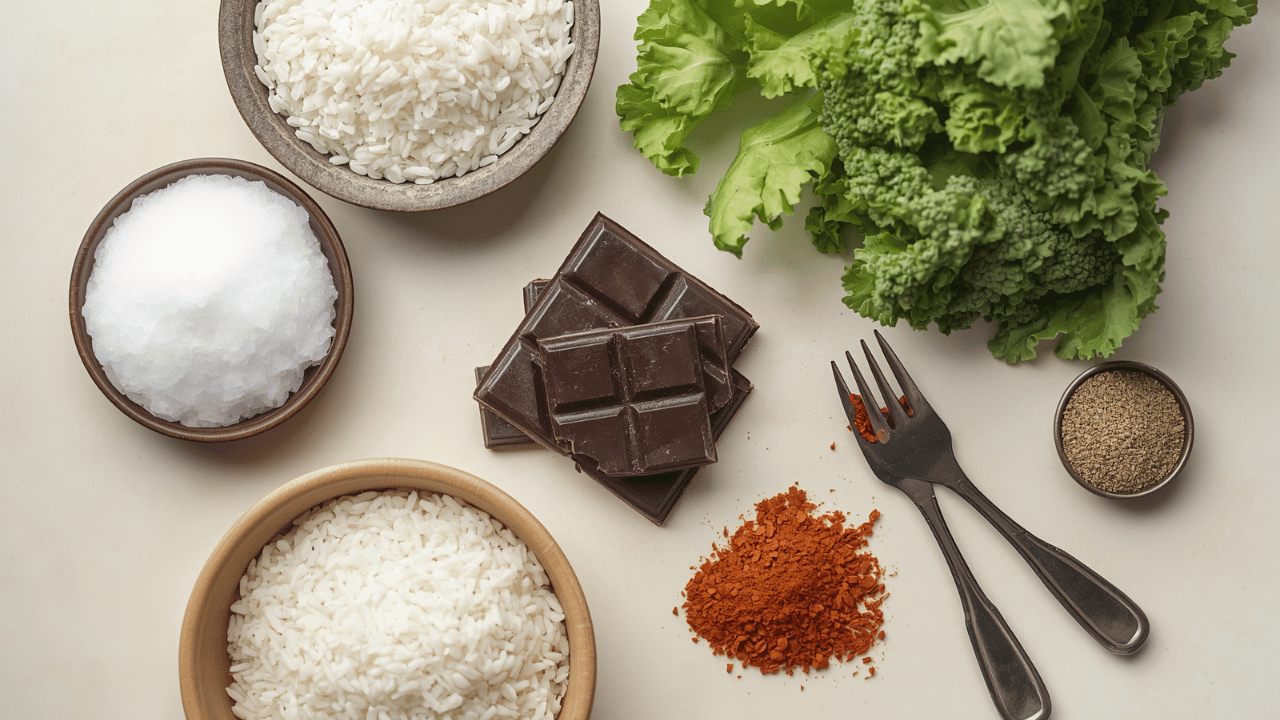
- A handful of categories accounted for most of my family’s regular dietary exposure: chocolate, rice, leafy greens and root vegetables, certain seafood, spices, and salts. Drinking water was another major source, but I addressed it with water filtration systems.
- Two products in the same category can differ enormously in heavy metals. In one dark-chocolate test, the highest-lead bar had roughly nineteen times more lead than the lowest. So choosing a lower-tested product in the foods you eat most often makes a real difference.
- A good question to consider is: “What’s my regular total heavy metals exposure via diet that I can reduce?” The choices you repeat are the ones that add up.
- High-impact choice: choose products that test lower in heavy metals in the categories you eat daily, diversify your diet, eat more nutrient-dense foods to help your body detoxify naturally, and take extra precautions before and during pregnancy, when lactating, and with young children.
I discovered heavy metals in food accidentally. Product by product.
It began with infant formula.
Then rice by-products.
Then rice.
Then spices.
Then salt.
Then dark chocolate.
Then milk chocolate.
And the list keeps growing.
Most recently, I spent over 140 hours diving into salt, wondering, Which salt is the healthiest? The question emerged as I watched family members and myself add salt to meals and snacks (we love homemade popcorn)—over and over, every day. Each time I noticed the use of salt, I wondered, With how much I spend on pricey salt products, which one offers the most nutrients? In trying to answer this question, I learned that salt too often contains heavy metals and microplastics. Was this safe? Do these exposures matter? Which salt brand is least contaminated? The volume of studies and analyses on contaminants in salt was both great for my research and disturbing.
Then dark chocolate, because I kept watching my daughters shave it onto homemade banana ice cream and smoothies night after night.
But before all that, it began with infant formula, when I learned that heavy metals were in some infant formula products. As with my deep dive into salt, I found study after study—this time on arsenic in rice and rice-based infant foods—as I tried to answer, Which infant formula is healthiest? Which is least contaminated? And I began to wonder, Why is there arsenic in so many infant formula products, including organic ones? Through that experience, my research led me to discover that brown rice syrup seemed to be a source of arsenic—so even organic infant formulas, the ones sweetened with brown rice syrup, sometimes had arsenic detected in them.
As I learned more about the widespread presence of heavy metals in our environment—and therefore our food—my questions evolved from Is this one food contaminated? to something broader. As the person buying most of what my family eats, I now think about what our cumulative weekly exposure to lead, cadmium, mercury, and arsenic is across everything we eat—and which choices actually move the needle.
This guide is the hub for that question. It synthesizes what I’ve found across the food categories where heavy metals show up most often, where the brand-to-brand or variety-to-variety differences are large enough to matter, and where small changes meaningfully reduce cumulative exposure over a year. Each category links to a deeper-dive article with the specific brands I now buy, the testing data I relied on, and the questions to ask if you want to evaluate any product on your own. A note on method: I don’t run the laboratory testing myself—this guide compiles and interprets independent testing from Consumer Reports, Mamavation, LeadSafeMama, and As You Sow, alongside FDA Total Diet Study data and peer-reviewed research.
On this page
- How I decide: five questions
- The four heavy metals that matter most
- Why cumulative exposure is the right frame
- Which popular foods contain heavy metals? (salt, chocolate, rice)
- Coming next in this series
- Seven principles for reducing exposure
- Special considerations for pregnancy & children
- Frequently asked questions
How I Decide: The Practical Nontoxic Living Approach in Five Questions
When I evaluate any dietary source of heavy metals, I don’t begin by asking whether a product is “safe.” No food is entirely free of these metals, so “safe” as an absolute isn’t a claim the science can support. Instead, I ask five questions—and every recommendation in this guide comes from running a category through them:
- Do we eat it often? Small exposures from daily habits usually contribute more to cumulative exposure than larger exposures from something we rarely eat.
- Are there meaningful differences between products? If every brand tests similarly, there’s little value in agonizing. When the gap between the highest and lowest products is large, the choice becomes real leverage.
- Is there an easy alternative? The most valuable changes are often the simplest—a different salt, another chocolate, a different rice variety, or a better cooking method.
- Would the change meaningfully reduce cumulative exposure? I focus on decisions that move the needle, not ones that simply create more work.
- Is the tradeoff worthwhile? Reduced exposure matters. So do taste, cost, convenience, family preferences, and the pleasure of eating well. This framework weighs all of them.
It’s the same approach I apply to everything else that enters our home.
The Four Heavy Metals That Matter Most in U.S. Diets
Of the dozens of heavy metals in the environment, four show up consistently in American food and account for most of the public health concern: lead, cadmium, mercury, and arsenic. All four are neurotoxic at chronic exposure levels common in U.S. diets. All four accumulate in the body. None are added to food—they are environmental contaminants in soil, groundwater, and post-harvest dust that crops absorb during growth or pick up during processing.
| Metal | Why it’s a concern | Common dietary sources |
|---|---|---|
| Lead | No safe blood level identified in children (CDC); crosses the placenta; stored in bone for decades | Dark chocolate, certain spices, root vegetables, leafy greens |
| Cadmium | Group 1 carcinogen (IARC); associated with kidney, cardiovascular, and neurodevelopmental effects | Dark chocolate, sunflower seeds, leafy greens, root vegetables, shellfish |
| Mercury | Methylmercury crosses the placenta and concentrates in the developing brain | Large predator fish (tuna, swordfish, king mackerel), and some salts |
| Arsenic | Inorganic form is a Group 1 carcinogen (IARC); concentrates in rice | Rice and rice-based products, certain seafood, some drinking water, fruit juices |
Lead
The CDC has stated that no safe blood lead level has been identified in children. Lead crosses the placenta. It is stored in bone for up to 30 years. The developing brain is the most vulnerable target, and children absorb lead from food at roughly four to five times the rate adults do. Of the four metals here, lead has the strongest evidence base for neurodevelopmental harm and the most stringent regulatory reference levels.
Cadmium
Cadmium is a Group 1 carcinogen classified by the International Agency for Research on Cancer (IARC). It has been associated with neurodevelopmental, kidney, and cardiovascular effects at chronic exposure levels common in U.S. diets. A 2012 cross-sectional analysis of U.S. NHANES data found that children in the highest quartile of urinary cadmium had approximately three times the odds of learning disabilities and special-education utilization compared with the lowest quartile (Ciesielski et al., 2012). This is an observational study, which can identify associations but not establish causation.
Mercury
Methylmercury, the form most concentrated in fish, crosses the placenta and accumulates in the developing brain. California has not identified any level of mercury exposure as free of reproductive-toxicity concern—regulatory language for “the science is sufficiently concerning that we cannot identify a level we’re confident is without risk.”
Arsenic
Inorganic arsenic, the form most concentrated in rice and rice-based products, is a Group 1 carcinogen classified by IARC. The FDA has been developing arsenic action levels for infant rice cereal under its Closer to Zero plan since 2021.
Why Cumulative Exposure Is the Right Frame
The right question is not whether one food is “safe.” It is what your daily total looks like across everything you eat and drink.
According to FDA’s 2020 analysis of Total Diet Study 2014–16 data, the average American adult’s estimated mean dietary lead exposure ranges from 1.7 to 5.3 micrograms per day—up to ten times California’s MADL of 0.5 micrograms per day at the upper-bound estimate (Gavelek et al., 2020). That is from food alone, before drinking water, household dust, or personal-care products. Cadmium, mercury, and arsenic add their own daily contributions from their own food sources.
The encouraging news is that exposure isn’t spread evenly across everything you eat. Independent testing turns up heavy metals again and again in a handful of categories: chocolate, rice, leafy greens and root vegetables, certain seafood, spices, and—depending on the products—salt. Which of these matters most for any one person depends on their diet, their water, and where they live, so I can’t say what tops your list—but these are the ones worth a closer look. Within each category, the brand-to-brand or variety-to-variety gap is often five-fold or more; in dark chocolate, it reached nineteen-fold in Consumer Reports’ 2022 testing of 28 bars. Choosing carefully within the categories you actually eat is where the leverage is.
Think of it as a daily budget
A useful frame: treat California’s MADL as a daily budget covering everything you eat and drink—0.5 µg/day for lead, 4.1 µg/day for cadmium. A food at “40% of MADL” for cadmium uses 40% of that day’s cadmium budget in a single serving, leaving 60% for everything else.
When a spinach salad uses 30% of your daily cadmium budget, a dark-chocolate ounce uses 40%, and a rice serving uses 25%, you’ve spent 95% in one meal. Choosing a lower-cadmium chocolate (10% instead of 40%) leaves room for the rest of the day. Small, consistent choices in the categories you eat most compound substantially over a year.
Which Popular Foods Contain Heavy Metals?
These are the categories where independent testing most consistently finds heavy metals—and where choosing carefully by brand or variety gave my family the most opportunity to reduce our exposure. They may be adding to yours, too. Salt, rice, and dark chocolate have published guidance below; seafood, leafy greens and root vegetables, and spices are in progress (see Coming Next). Each published category links to a deeper-dive guide with the specific brands I now buy, the testing data, and practical evaluation questions.
Kitchen staple
Heavy Metals in Salt
LeadCadmiumMercuryArsenicAluminum+ Microplastics
Why it deserves attention: Americans consume an average of 3,400 mg of sodium per day, mostly from salt—making brand selection unusually high-leverage for a category most people never think about. Independent testing by Mamavation, LeadSafeMama, and manufacturer data shows substantial brand-to-brand differences: Himalayan pink and many sea salts have tested higher for both heavy metals and microplastics, while certain refined kosher and well-sourced mined salts have tested lower.
Decision principle: Salt is a daily habit, so I prioritize brands backed by independent testing over marketing claims or trendy varieties.
What I keep in my kitchen: Diamond Crystal Kosher Salt.
Read the salt guide →Daily ritual for many
Heavy Metals in Dark Chocolate
LeadCadmium
Why it deserves attention: Every dark chocolate independently tested in the U.S. over the past decade contains both metals. In Consumer Reports’ 2022 testing of 28 bars, the brand-to-brand gap was nineteen-fold for lead and five-fold for cadmium—and cacao percentage and price did not predict contamination; brand and sourcing region did. The 2024 Hands et al. peer-reviewed analysis of 72 dark chocolate and cocoa products (four testing rounds, 2014–2022) found 43% exceeded California’s MADL for lead and 35% for cadmium. Popular-brand status did not predict lower levels.
Decision principle: When the gap between products is this wide, brand selection is the whole game—I choose a bar that tested below the MADL for both metals and keep the ritual.
What I keep in my kitchen: Mast Organic Dark Chocolate 80%—my top pick among the bars that tested below California’s MADL for both lead and cadmium in Consumer Reports’ 2022 panel.
Read the dark chocolate guide →Common first food for infants
Arsenic in Rice
Inorganic arsenic (Group 1 carcinogen)
Why it deserves attention: Rice absorbs arsenic from soil and water more efficiently than nearly any other grain, and rice-based products are common first foods for infants—exactly the population most vulnerable. FDA’s Closer to Zero plan has been developing rice action levels since 2021. Variety and origin matter: white basmati from California, India, and Pakistan, and U.S. sushi rice, tend to test lowest; brown rice tends higher than white (arsenic concentrates in the bran).
Decision principle: Because rice is eaten often and the cooking method itself changes the result, I choose lower-tested varieties and change how I cook it first.
The cooking method that helps: cook rice in excess water (6 parts water to 1 part rice), then drain like pasta—which can reduce arsenic content by 40–60% depending on variety.
Read the rice guide →Coming Next in This Series
The categories I’m researching next, in roughly the order I plan to publish—chosen where the contamination signal is strongest and the brand or variety variation matters most for everyday shopping.
- Cocoa powder, chocolate chips, hot cocoa, and baking mixes. The companion to the dark-chocolate post. Cocoa powder is concentrated cocoa solids, so per-tablespoon math differs from bars; hot cocoa mixes were the worst category in Consumer Reports’ 2023 testing (four of six exceeded MADL for lead per serving).
- Milk chocolate. Generally lower than dark chocolate (less cocoa solids), but not heavy-metals-free—and children, who eat more of it, are especially vulnerable.
- Dark vs. milk chocolate: the trade-offs. Flavanol content, heavy-metals load, sugar, and dose-response on cardiovascular associations, in one place.
- Leafy greens and root vegetables. Spinach, kale, sweet potatoes, and carrots absorb cadmium and lead more efficiently than most produce; FDA Total Diet Study data consistently flags these among the produce that tests highest for cadmium and lead.
- Baby and infant food. FDA’s Closer to Zero has been issuing draft action levels; a 2021 Congressional investigation found measurable lead, cadmium, mercury, and arsenic across major brands.
- Spices. Recent FDA testing has found elevated lead in certain ground spices (especially cinnamon); the 2023 cinnamon-applesauce recall showed how fast exposure can build from one product.
- Seafood. The mercury-vs-omega-3 trade-off varies dramatically by species; “eat fish twice a week” hides large differences between, say, sardines and tuna.
- Protein powders and supplements. Independent testing consistently finds lead and cadmium in a significant share; plant-based powders test higher on average than whey.
If there’s a category you’d like me to prioritize, the easiest way to tell me is to reply to any email in the Ultimate Home Detox Kickstart Series once you’ve subscribed—your replies come to my inbox.
Subscribing to my podcast and joining me on Substack are effortless ways to follow my latest findings—and the questions I’m asking as I research each new category.
Seven Principles for Reducing Cumulative Exposure
A few practical principles that apply across every category in this series:
- Research your regular sources of chronic exposure, then choose safer alternatives. Start by identifying the foods you eat often enough to add up, then swap in lower-tested brands or varieties where the differences between products are large. Every principle below refines this first one.
- Variety reduces cumulative risk. No single food is the dominant source for most people. Rotating brands, origins, and varieties within a category reduces the chance that any one contamination pattern dominates your intake.
- Frequency matters more than dose. A handful of chocolate chips once a month isn’t the concern. A daily dark-chocolate ritual or a daily rice-based breakfast is where exposure builds. Focus your attention where your eating frequency is highest.
- Children, pregnancy, and nursing warrant extra care. Developing brains are uniquely vulnerable, and children absorb lead from food at roughly four to five times the adult rate, gram for gram. A diet that’s reasonable for a 45-year-old may not be for a 3-year-old or a pregnant woman.
- Independent third-party testing beats marketing claims. “Clean,” “pure,” “organic,” and “Prop 65 compliant” are not testing data. A current Certificate of Analysis with per-serving values in micrograms is. Brands that publish their testing are generally doing more work on the problem.
- Pair these foods with ones that reduce absorption. Iron, calcium, and zinc have all been associated with reduced gut absorption of lead and cadmium. A spinach salad with sesame seeds, cheese, and a squeeze of lemon is doing more than tasting good.
- Watch for regulatory updates. FDA’s Closer to Zero plan is the most important U.S. food-contaminant development in a decade. As action levels for chocolate, rice, and baby food finalize, the brand landscape will shift.
Special Considerations for Pregnancy and Young Children
All four metals cross the placenta, accumulate in the body, and are associated with neurodevelopmental harm at chronic exposure levels common in U.S. diets. For pregnant readers, nursing parents, and families with young children, the cumulative-exposure question is not abstract: developing brains are the most vulnerable window, and the same intake delivers a much larger effective dose to a child than to an adult.
The practical implication is rarely to eliminate a food category. Cutting dark chocolate in pregnancy removes cocoa flavanols that some research has associated with reduced preeclampsia risk; cutting rice removes a major source of B vitamins and folate. The better move is choosing the lower-tested option within each category, keeping portions modest, and rotating brands or varieties so no single contamination pattern dominates.
- During pregnancy: choose the lowest-tested options in dark chocolate, salt, and rice; keep portions modest; avoid daily consumption of any single high-contamination food; cook rice in excess water and drain; discuss specific concerns with your obstetrician or a registered dietitian.
- For infants and toddlers: limit or rotate rice-based first foods (cereal, rice milk, rice crackers). FDA’s draft action levels for baby food are still being finalized; brands with public third-party testing are the better bet.
- For young children: treat dark chocolate as a special-occasion item. Milk chocolate, while not heavy-metals-free, is generally lower per serving (less cocoa solids). Build in iron-, calcium-, and zinc-rich foods to reduce absorption of any lead or cadmium consumed.
What We Don’t Yet Know
The evidence on dietary heavy metals is strong on some questions and thin on others. Naming both is part of the work.
Well-established: lead, cadmium, mercury, and arsenic are present in detectable quantities across essentially the entire American food supply; all four cross the placenta and accumulate over time; the CDC has stated there is no safe blood lead level in children; each has been associated with neurodevelopmental, cognitive, or carcinogenic effects at chronic exposure levels common in U.S. diets; and brand- and variety-level differences within categories are typically large enough that informed selection meaningfully reduces exposure.
Still uncertain: how much of any individual’s chronic exposure comes from each source varies by consumption pattern, location, water supply, and personal-care routine. California’s MADL is the strictest publicly available U.S. reference, but it is a precautionary reproductive-toxicity benchmark, not a harm threshold. FDA’s food-category action levels under Closer to Zero remain in progress for most categories. And the interaction effects among these metals at real-world simultaneous chronic doses—including possible co-exposure synergy—are not fully characterized.
What a precautionary approach suggests: where testing exists, choose lower-tested options; where it doesn’t, ask for a Certificate of Analysis—and treat any single category as one input to your daily total, not a verdict on its own.
I’ll update this guide as new testing rounds, regulatory standards, and peer-reviewed research emerge—and I talk through new findings as they surface on the Practical Nontoxic Living podcast. The fastest way to receive updates is the free Ultimate Home Detox Kickstart Series.
The Bottom Line
Heavy metals are not a problem you can opt out of—they are a baseline condition of eating in the modern food supply. But the within-category variation is large enough that paying attention to the few foods you eat most often genuinely reduces your family’s cumulative exposure over a year.
You don’t need to track every bite. Focus on the few foods you eat most often, choose a little better there, and let the small, repeated choices do the work over a year.
This guide will keep growing as I publish each new category. The full set lives here, and the underlying research framework—Practical Nontoxic Living—applies the same approach across cleaning products, personal care, household furnishings, and the rest of the home. You can begin with the free Ultimate Home Detox Kickstart Series.
Frequently Asked Questions
What foods have the most heavy metals?
Independent testing and FDA Total Diet Study data most often flag these categories: dark chocolate and cocoa products (lead and cadmium), rice and rice-based products (inorganic arsenic), certain seafood (mercury, especially large predator fish), leafy greens and root vegetables (cadmium and lead—especially spinach, sweet potatoes, and carrots), spices (lead, especially certain cinnamon products), and certain salt products (variable amounts of multiple metals). How much any one of these adds to a given person’s total depends on their diet, water, and location—so there’s no single answer for everyone. Drinking water, household dust, and personal-care products also contribute to total daily exposure.
Which heavy metal in food is the most harmful?
All four—lead, cadmium, mercury, and arsenic—are neurotoxic and accumulate in the body. But lead has the strongest evidence base for harm in children, and toxicologists treat it with the most caution. The CDC has stated no safe blood lead level has been identified in children, and California’s MADL for lead (0.5 µg/day) is set roughly eight times more stringently than for cadmium (4.1 µg/day), reflecting lead’s greater severity at low doses. Mercury and arsenic carry their own serious concerns, but their contribution to most people’s daily intake is smaller than lead and cadmium.
How can I avoid heavy metals in food?
Focus on the categories you eat most often. Choose lower-tested brands within them when independent testing is available. Rotate brands, origins, and varieties. Pair these foods with iron-, calcium-, and zinc-rich foods, which have been associated with reduced gut absorption of lead and cadmium. Cook rice in excess water (6:1) and drain. Limit large-predator fish if seafood is regular. Be especially careful during pregnancy and for young children, whose developing brains are most vulnerable.
What foods help reduce heavy-metal absorption?
Certain nutrients are associated with reduced gut absorption of lead and cadmium—especially iron, calcium, and zinc. Building meals around iron-, calcium-, and zinc-rich foods is associated with lower absorption of any lead or cadmium eaten alongside them, and a varied, fiber-rich, nutrient-dense diet helps by limiting how much any single contaminated food contributes to your daily total. This supports the body’s normal handling of these metals; it is not a treatment for heavy-metal poisoning, which requires medical care.
Are organic foods lower in heavy metals?
Not consistently. Organic certification regulates synthetic pesticide and fertilizer use—neither of which is the primary source of heavy-metal contamination in most foods. The 2024 Hands et al. analysis of dark chocolate found organic products averaged slightly higher lead and cadmium than non-organic, likely because of sourcing region. Organic is valuable for other reasons, but it doesn’t reliably predict lower heavy-metal content.
Should you worry about heavy metals in food?
Heavy metals are present across essentially the entire food supply, so the goal is not to panic or to eliminate categories, but to reduce cumulative exposure where it’s easy to do so. Because brand-to-brand and variety-to-variety differences within a category are often large, choosing lower-tested options in the foods you eat most often meaningfully lowers your total. Extra care is warranted during pregnancy and for young children, whose developing brains are the most vulnerable.
What is California’s MADL, and why do researchers use it?
The Maximum Allowable Dose Level (MADL) is the strictest publicly available U.S. reference for daily lead and cadmium exposure: 0.5 µg/day for lead, 4.1 µg/day for cadmium. California scientists identify the lowest dose at which a chemical produces a measurable reproductive effect, then divide by 1,000 for a precautionary margin. The FDA does not currently set daily intake limits for either metal in most adult foods, and WHO and EFSA guidelines allow substantially higher exposures. The MADL is a precautionary benchmark, not a harm threshold—but it is the most protective publicly available U.S. reference.
The framework behind the swaps
This guide walks through the everyday food categories where independent testing keeps finding heavy metals. The Ultimate Home Detox Kickstart Series shows you why these swaps matter—the same evidence-based framework applied to cleaning products, personal care, household furnishings, and the rest of your home.
Small, sustainable changes that compound into meaningful reduction over time.
Start the free Kickstart Series →About the Author
Sophia Ruan Gushée is a citizen researcher, author, and mother of three whose work in environmental and public health has investigated everyday toxic exposures for nearly two decades. She is the founder of Ruan Living and the creator of Practical Nontoxic Living—a research-grounded framework for reducing toxic exposures that respects the time, attention, and constraints of real families. She is the author of A to Z of D-Toxing (2015) and the EMF Detox Workbook, has served on the Brown University School of Public Health Advisory Council and the Well+Good Council, and holds a bachelor’s degree from Brown University and an MBA from Columbia Business School.
Connect: Practical Nontoxic Living Podcast • Substack • Instagram • LinkedIn
Research Sources
FDA Total Diet Study dietary lead exposure: Gavelek, A. et al. (2020). Lead exposures in older children, women of childbearing age, and adults: FDA Total Diet Study 2014–16. PubMed 31647750
Cadmium and neurodevelopment (NHANES): Ciesielski, T. et al. (2012). Environmental Health Perspectives, 120(5), 758–763. PMC3346779
Multi-year heavy-metal analysis of dark chocolate: Hands, J.M. et al. (2024). Frontiers in Nutrition, 11, 1366231. PMC11321977
Arsenic in organic brown rice syrup: Jackson, B.P. et al. (2012). Arsenic, Organic Foods, and Brown Rice Syrup. Environmental Health Perspectives, 120(5). PubMed 22336149
Neurodevelopment systematic review (LMIC): Heavy metals and neurodevelopment of children in low and middle-income countries (2022). PMC8970501
Heavy metals and neurodevelopment (2025 review): Toxics (2025). PMC12386800
CDC blood lead level statement: About Childhood Lead Poisoning Prevention
Regulatory frameworks: California OEHHA Prop 65 • FDA Closer to Zero
Educational content disclaimer: This guide is for educational purposes and reflects available data as of July 2026. It is not medical advice. Individual experiences vary. If you are pregnant, breastfeeding, or have specific health concerns about heavy-metal exposure, consult a qualified healthcare professional. This guide is not intended to diagnose, treat, cure, or prevent any disease.
Ruan Living offers education in environmental and public health. It is not medical advice and does not diagnose, treat, cure, or prevent any disease. Individual experiences vary. Learn more.